

AI’s 1998 Moment? The Stock Market Is Sending Us a New Warning. Stock Talk Update October 30, 2026

The Three Major Points
| 1. AI stocks vs. earnings | 2. Credit becomes the warning | 3. Cost of money rises |
| AI and semis corrected, but forward earnings kept rising. Multiple compression, not yet an earnings collapse. | Credit is separating cash-rich hyperscalers from leveraged AI infrastructure. The financing model is being tested. | Real rates, the dollar and European sovereign stress tightened financial conditions. This is the new macro hurdle. |
OPEN – SOMETHING CHANGED IN OCTOBER
Welcome back to Stock Talk.
For more than a year, we’ve compared today’s AI boom with the dot-com cycle.
And recently we’ve argued something important: Maybe we’re looking at the right movie – but the wrong scene.
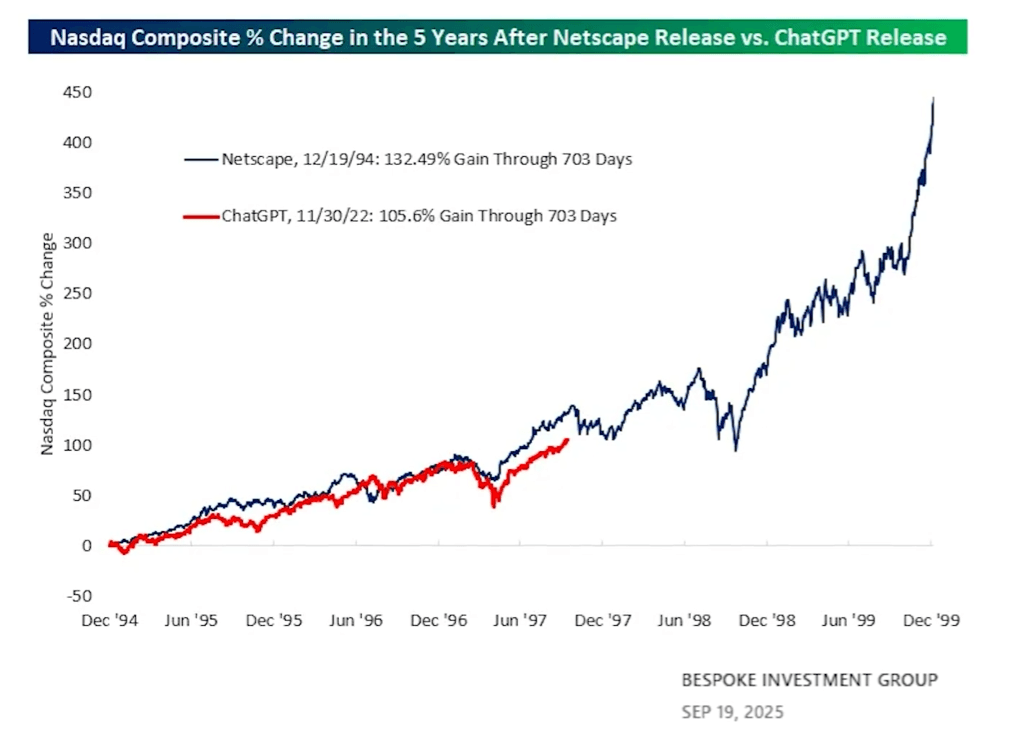
The Bespoke Netscape-versus-ChatGPT comparison suggested today’s AI cycle looked more like 1998 than March 2000. I still think that’s the right question.
But over the last four weeks – something changed.
AI stocks fell. Semiconductors got hit even harder. Interest rates jumped. The dollar strengthened. Europe developed a serious new problem in France. And most important – credit markets started questioning the AI buildout.
That’s new.
But here’s the contradiction: While AI stocks fell – AI earnings estimates went UP.
So today we’re going to answer one question: Is October 2026 the beginning of the AI bust – or another 1998-style reset before the cycle continues?
I’ve got three points.
POINT ONE – AI STOCKS FELL, BUT AI EARNINGS DIDN’T
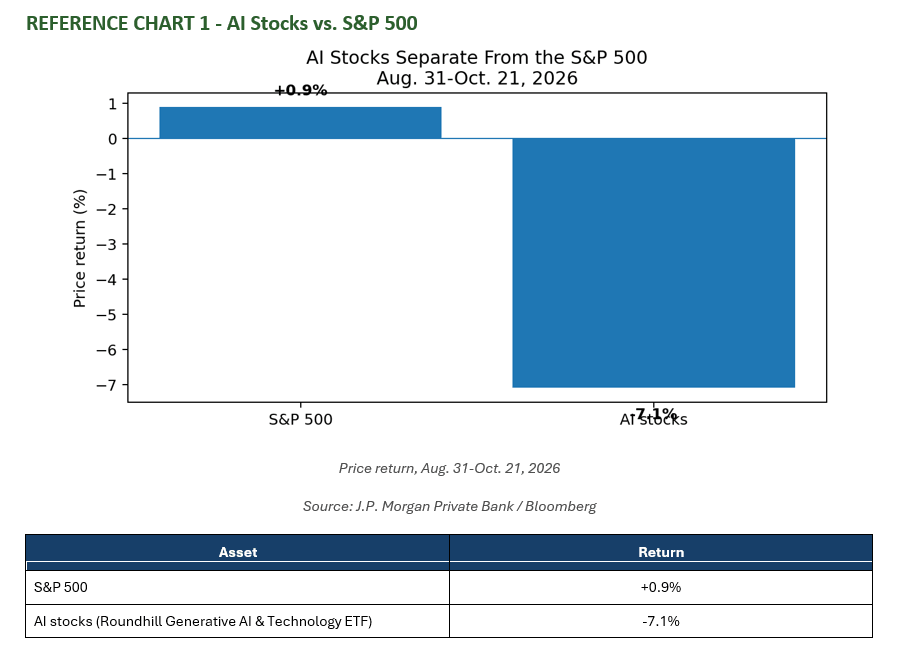
Let’s start with the scoreboard.
J.P. Morgan looked at AI stocks from August 31 through October 21. The S&P 500 was +0.9%. AI stocks, measured by the Roundhill Generative AI & Technology ETF, were -7.1%.
At one point in early October, AI stocks were almost 10% higher. Then they fell roughly 20 percentage points from that high. That’s a real correction.
And semiconductors have been even weaker. From October 6 through October 15, SOXX fell 12.7%. Technology fell 6.3%. But the equal-weight S&P 500 actually rose 1.3%. Health care and consumer staples rose about 6%. Energy rose more than 4%.
That looks less like ‘Sell everything’ and more like ‘Sell yesterday’s winners and rotate somewhere else.’
Citadel Securities saw the same thing. On October 7, the S&P 500 Equal Weight relative to the Nasdaq 100 reached its lowest level since April 2000. Then it reversed. Over the next three sessions, equal weight beat the Nasdaq 100 by 2.8% – a 95th-percentile move historically. That’s leadership broadening.
BUT HERE’S THE WEIRD PART
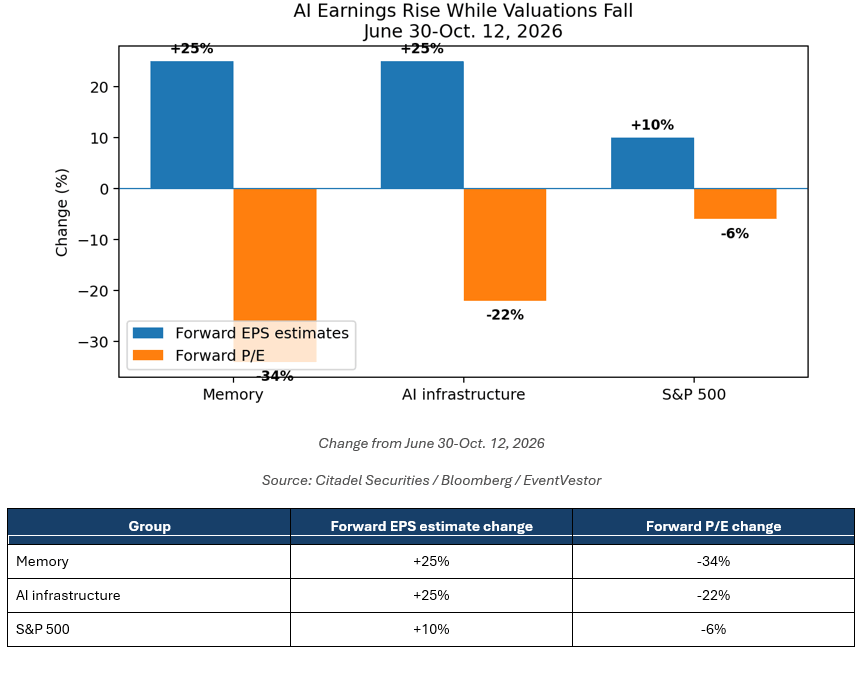
Normally, when a stock falls hard, you’d expect earnings estimates to fall too. That’s not what’s happening.
Since June 30, Citadel calculates: memory earnings estimates +25%; AI infrastructure earnings estimates +25%; S&P 500 earnings estimates +10%.
But simultaneously: memory P/E -34%; AI infrastructure P/E -22%; S&P 500 P/E -6%.
That’s multiple compression, not an earnings collapse.
And FactSet backs this up. Analysts actually raised Q3 S&P 500 earnings estimates by 1.4% during the quarter. Normally they cut them. FactSet says the average quarterly estimate falls about 2.5% over the past decade. FactSet thinks Q3 earnings growth could ultimately finish above 35%.
So our first conclusion is: Price action says caution. Earnings don’t say recession. That’s very different from the final stage of dot-com.
POINT TWO – THE NEW WARNING ISN’T STOCKS. IT’S CREDIT.
This is the section I think matters most.
For most of the AI boom, the biggest companies could finance AI spending from enormous internal cash flow: Microsoft, Alphabet, Amazon and Meta. That made this cycle very different from dot-com.
But the buildout has become so large that AI is increasingly reaching into the bond market. And bond investors aren’t nearly as forgiving as stock investors.
Citadel Securities put it perfectly: ‘The AI boom is discovering that capital has a cost.’ That’s our new risk.
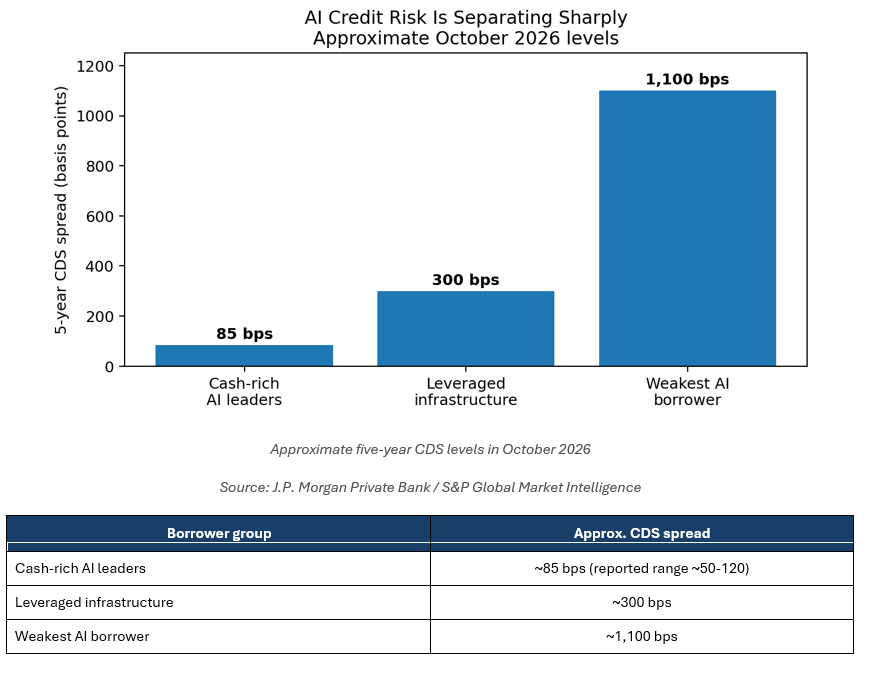
J.P. Morgan looked at credit-default swaps – the price investors pay to insure corporate debt against default.
For large, cash-rich AI companies, CDS spreads are roughly 50 to 120 basis points. Elevated – but hardly distress. Move into more leveraged infrastructure companies and you’re approaching 300 basis points. Then go to the weakest debt-dependent AI borrowers: around 1,100 basis points. That’s more than $1 million a year to insure $10 million of debt.
AND COREWEAVE SHOWS WHAT HAPPENS WHEN EQUITY AND CREDIT AGREE
CoreWeave shares lost roughly a quarter of their value during the October selloff. Its unsecured 2032 bonds approached a 15% yield. Its CDS went above 1,100 basis points.
Oracle’s CDS has approached roughly 300 basis points. Meta’s CDS has also widened as investors focus on rapidly growing AI spending and debt issuance.
But here’s the key: Broad investment-grade credit has NOT blown out. J.P. Morgan describes this as a targeted repricing, not broad corporate distress. That’s hugely important.
THE DOT-COM ANALOGY JUST GOT BETTER
Remember what eventually hurt dot-com? It wasn’t that the Internet stopped working. The Internet changed the world. What broke was the financing model.
Too much money chased infrastructure. Returns couldn’t justify the cost of capital. Then the marginal source of financing disappeared.
That’s the risk we’re beginning to test in AI. Not: ‘Is AI real?’ Clearly it is. The better question is: Who earns enough on AI to pay for all this infrastructure?
POINT THREE – THE COST OF MONEY JUST WENT UP
Now let’s connect stocks and credit to the bond market. This is where our September Stock Talk needs an update.
On September 18, the 10-year Treasury was around 5.0%. It then climbed above 5.30%. As of Friday, October 23, it was still about 5.0%.
Citadel calculates that during September, the 10-year yield rose 54 basis points. Only 5 basis points came from inflation expectations. Forty-nine basis points came from real interest rates.
The bond market wasn’t mainly saying, ‘Inflation is exploding.’ It was saying, ‘Capital is worth more.’ Today the 10-year real Treasury yield is around 2.6%-2.7%, versus only about 1.7% a year ago. That’s a major change for companies borrowing billions to build data centers.
THE DOLLAR IS JOINING THE PARTY
The dollar index was about 99.5 in mid-September. By mid-October it was above 102. It closed October 23 around 101.8.
A stronger dollar tightens global financial conditions. It makes dollar debt more expensive internationally and can reduce translated overseas earnings for U.S. multinationals. Once again – very similar to parts of the late-1990s setup.
AND NOW EUROPE HAS A PROBLEM
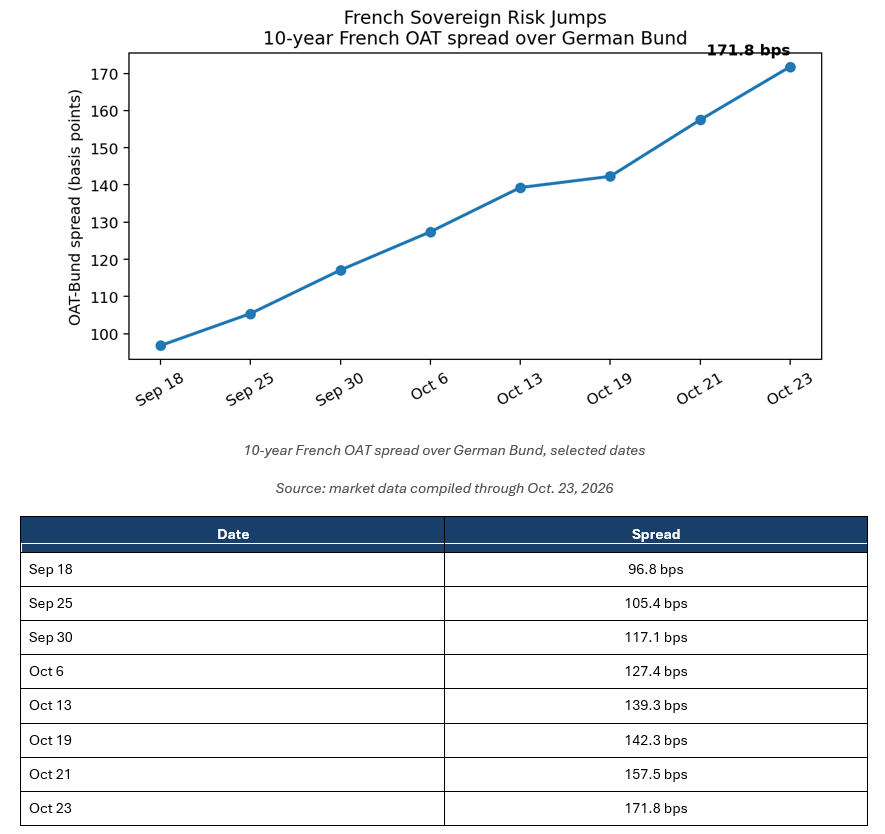
France has become the latest source of global financial stress.
On September 18, France’s 10-year government bond yielded about 4.47%. By October 23: roughly 5.05%. More importantly, France’s yield premium over Germany exploded from roughly 97 basis points to 172 basis points.
J.P. Morgan says this is still primarily a France-specific fiscal and political repricing, not a replay of 2011-12. But it matters because global capital markets are connected.
The final stage of great bull markets often doesn’t end when everybody notices stocks are expensive. It ends when liquidity gets scarce somewhere unexpected.
SO IS THIS 1998 – OR 2000?
Here’s my answer. Right now, I still lean closer to 1998 – but with an important new warning light.
First: Earnings aren’t breaking. Citadel says consensus entered Q3 looking for about 27% S&P earnings growth. FactSet thinks the final number could exceed 35%.
Second: Valuations have already reset. At the end of September, S&P 500 forward P/E was 19 times, Nasdaq 100 was 21.7 times, and semiconductors were 17.1 times. Semiconductor multiples had fallen 31% from their 2026 high and were actually below the S&P 500 multiple. That’s very different from March 2000.
Third: The selling isn’t broad enough yet. Citadel notes we’ve gone almost an entire year without an 80% downside-volume day on the NYSE. Historically, the average year has about 21. Investors aren’t abandoning stocks. They’re rotating.
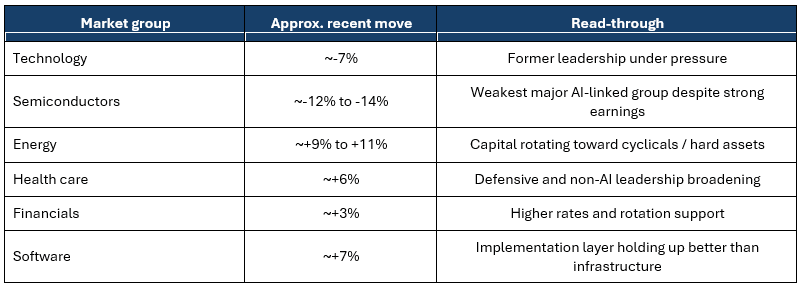
AND THAT ROTATION IS IMPORTANT
Over roughly the last month, technology fell about 7%. Semiconductors fell about 12% to 14%. But energy rose roughly 9% to 11%, health care about 6%, financials about 3%, and software about 7%.
That’s very interesting given our recent Stock Talk: ‘Living in a Material World.’ Money may already be moving away from pure AI infrastructure toward other areas of the market.
Again – that doesn’t mean AI is finished. It means leadership is changing, just as it did repeatedly during the 1990s.
WHAT WOULD MAKE ME CHANGE MY MIND?
Here’s my dashboard. I would become much more concerned if three things happen together.
ONE – AI earnings estimates start falling. Not stocks. Earnings. If forward semiconductor, memory and hyperscaler earnings estimates roll over – that’s different.
TWO – Credit stress spreads from weak AI borrowers into the broad market. CoreWeave at 1,100 basis points is a warning. But if broad CDX investment-grade and high-yield spreads begin moving sharply higher – now we’ve got a different problem. That’s when a technology correction can become a liquidity event.
THREE – Real rates keep rising while the dollar and European stress rise with them. A 5% 10-year Treasury isn’t automatically fatal. But a 5% Treasury – plus rising real rates – plus a stronger dollar – plus widening credit spreads – plus European sovereign stress – starts looking a lot more like the ingredients that eventually ended the late-1990s party.
CLOSE – AI JUST ENTERED ITS NEXT TEST
The last month has not convinced me that AI is over. But it has changed the question.
Six months ago investors were asking: ‘How big can AI get?’ Now they’re beginning to ask: ‘Who is going to make enough money to pay for it?’
The strongest AI companies have enormous earnings and cash flow. The weakest AI infrastructure companies need the capital markets to stay open. Those are not the same investment. And credit markets are finally treating them differently.
That actually gives me some comfort. Bubbles become most dangerous when investors stop caring about differences. Right now – the market is becoming more selective, not less.
Semiconductors are correcting despite rising earnings estimates. Weak borrowers are paying much more for money. The average stock is beginning to outperform mega-cap technology. Health care, financials, energy and software are attracting capital. And earnings growth remains extremely strong.
So maybe this still is our 1998 moment: a violent rotation, higher rates, global stress, technology correcting, credit beginning to discriminate – but the underlying earnings cycle still alive.
The next four weeks will tell us a lot: Microsoft, Alphabet, Amazon, Meta, and eventually Nvidia.
The question isn’t whether they spend another hundred billion dollars. We already know they’re spending. The question is: What return are they getting on that money?
Because that is where the AI boom becomes either the next great productivity cycle – or the next great capital-spending bust.
And that’s what we’ll be watching.
FINAL SCREEN – THE AI DASHBOARD
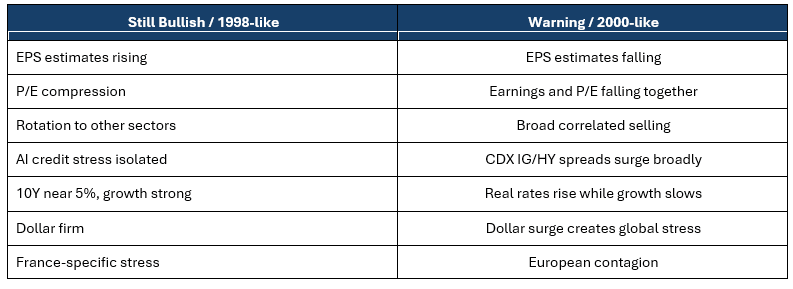
| Still Bullish / 1998-like | Warning / 2000-like |
| EPS estimates rising | EPS estimates falling |
| P/E compression | Earnings + P/E falling together |
| Rotation to other sectors | Broad correlated selling |
| AI credit stress isolated | CDX IG/HY spreads surge broadly |
| 10Y ~5%, growth strong | Real rates rise + growth slows |
| Dollar firm | Dollar surge creates global stress |
| France-specific stress | European contagion |
Don’t ask whether AI stocks are falling. Ask whether AI earnings – and the credit needed to finance them – are breaking.
Selected Sources / Production Notes
- P. Morgan Private Bank – Credit Markets Look for AI’s Weak Links.
- Citadel Securities – Global Market Intelligence October Update; October: The Q4 Reload; Macro Thoughts on AI fixed income and real rates.
- FactSet Earnings Insight – Q3 2026 estimate revisions and earnings-growth updates.
- Market data through October 23, 2026 for U.S. Treasury yields, U.S. Dollar Index, and French OAT/German Bund spreads.
- General information only. Not financial advice. Past performance does not guarantee future results.
Chris Perras
CFA®, CLU®, ChFC®
Chief Investment Officer, Financial Advisor
Chris is a seasoned investment professional with over 25 years of experience working with some of the most successful money management firms in the world. Chris has made it a point in his career to adapt as the market landscape changes, seeking to utilize the appropriate investment strategy for a given market environment. His transition from managing billions of dollars at the institutional level to helping individuals and families retire is guided by a desire to see first-hand the impact he is making in the lives of clients at Oak Harvest.
Click to subscribe: