

From Dot-Com Bubble to AI, “Situationally UnAware” Stock Talk Update August 7, 2026
The Three Major Points
| 1. “Smartest investor” unwind | 2. Capex and semiconductors | 3. How the cycle breaks |
| Vilar/Amerindo after March 2000 and Aschenbrenner/Situational Awareness in July 2026 show that a correct technology thesis can still fail when concentration, leverage, liquidity and valuation collide. | Both cycles required a physical infrastructure buildout. The dot-com cycle centered on fiber and telecom equipment; the AI cycle centers on semiconductors, memory, networking, data centers, power and cooling. | Both cycles faced rising rates, a strong dollar, higher oil and tighter liquidity. The major difference is that today’s leaders produce substantial earnings and cash flow, although massive capex is now consuming much more of that cash. |
WHEN THE “GENIUS” TRADE BREAKS
Every great investment cycle creates a hero, or two. Someone who sees the future early, makes an early and correct investment, and starts looking like the smartest investor in the world.
The cycle grows, and then others see it as well and it accelerates, many times going parabolic. Then the cycle turns. Liquidity disappears. De-Leveraging takes control. And the trade that proved how early and smart the investor was, becomes the trade that nearly destroys or totally destroys the fund. At best, they are known as a one hit wonder, at worst, investors lose most if not all of their capital and the manager become a history lesson.
That happened in the dot-com era in 1998-2000. And it happened again in the AI cycle just last week.
Today, we are going from the dot-com bubble to AI – and asking a simple question: what can retirees learn when the cycle’s “smartest investor” trade breaks?
THREE POINTS, TWO CYCLES
Let’s frame this once again, as our team has for almost a year and a half. I want to make three comparisons. Dot.com 1998-2000 versus AI 2025-current.
First off, early in my career, I lived, analyzed, invested, and escaped the Dotcom bubbles implosion in the late 90’s. I lived and worked in San Fran for a number of years through and into the height of the Dotcom build out that would become a financial market, and mainly tech stock bubble. My first son Kyle was born in San Francisco in late 1997 as the bubble was progressing. By mid-1999, post LTCM blowing up in October 1998, Texas called me and my family back “home”, I left the world of almost tech only investing, and we moved back to Houston. However, my nearly 3 years in the Bay area focusing primarily on Tech companies put me within close contact to some of the earliest and smartest tech minds I’ve ever met. Back then, a firm named Amerindo, run by Alberto Villar, was hailed as one of the leading public market investors in Dotcom technology stocks. Last week’s epic hedge fund blowup by Leopold Aschenbrenner and Situational Awareness got me back in Deja Vue mode.
My Second point, as we addressed a few weeks ago, capital-spending booms – especially large, fixed cost ones including technology ones in semiconductor equipment, memory and networking supply chains have seen these booms, and busts before.
Finally, how and why the dot-com bubble finally broke, and why today’s mix of interest rates, the dollar, oil and inflation, looks all too familiar – even though profits and valuations are very different.
FROM DOT-COM BUBBLE TO AI, “SITUATIONALLY UNAWARE”
In most every technology boom, many investors confuse being right about the future with being protected from the present.
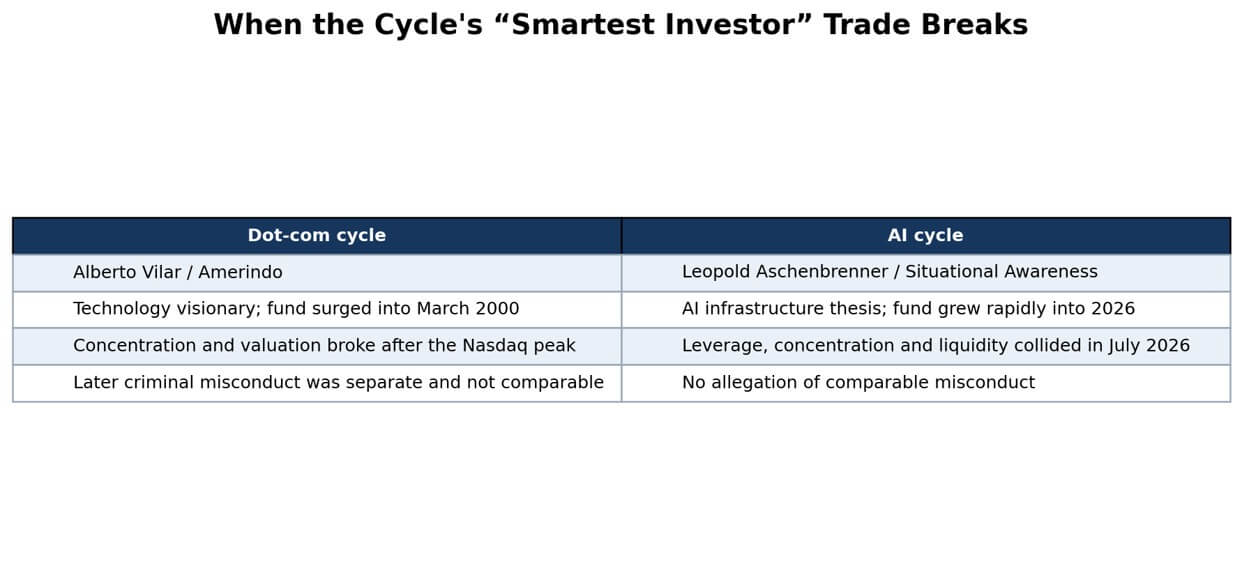
Back in Dotcom era of 1995-2000, Alberto Vilar was one of the dot-com era’s most celebrated technology investors in the valley. Amerindo’s technology fund produced spectacular gains and money flooded into the company in new AUM. Vilar argued that the internet would transform business and daily life. On technology, he was early and history has said if anything he underestimated the changes it would bring to our lives. But as an investor, Amerindo was concentrated in only technology shares just as the Nasdaq peaked in March 2000. When liquidity slowed and eventually dried up, valuations reversed, and the fund’s public investment vehicle collapsed. In Amerindo’s case, it was a bit of a slow-motion train wreck, as the fund was not heavily leveraged to magnify already high returns. So, the fund was wound down and shut down over a few years. There’s a little more to this story, but you can google that part.
Over the last 2+ years, a similar story has repeated on an even grander and larger scale of money.
Leopold Aschenbrenner, an early 20 year old tech investor, built a hedge fund, “Situational Awareness” from a few hundred million in AUM a couple of years ago into billions, on a directionally correct thesis. On June 6th, 2024 he published a 165 page paper title “Situational Awareness- The Decade Ahead”. Here’s the link for those who want to read it. It is brilliant. https://situational-awareness.ai/wp-content/uploads/2024/06/situationalawareness.pdf
The thesis he wrote about: AI would require enormous amounts of compute, semiconductors, memory, networking, electricity and capital. Situational Awareness grew rapidly and reportedly reached about $45 billion dollars in assets and commitments into the early June technology peak, less than 60 days ago.
But the fund combined concentrated AI infrastructure positions with substantial borrowing. It’s been reported the fund was leveraged as much as 4 to 1, meaning for every 1$ of client money, Leopold borrowed $3-4 more to invest. Investors, margin and leverage look good on the way up, BUT?! In July 2026, AI stocks, semiconductors, and the momentum investing factor fell out of favor and many of the fund’s holdings plunged 20-45% in less than 20 trading days. That’s hard to stomach in an unleveraged portfolio, but when you’re borrowing others money, it can turn downright toxic, and business threatening. In July, just after the second quarter ended – creditors started demanding cash,asking the fund to put up more collateral or face forced liquidation. Leopold couldn’t find the capital quickly enough, public positions were sold, and the fund reported a 67 percent monthly decline. The fund has reportedly survived, but the “AI genius” trade became a liquidity event.
The lesson here is not that the AI investment cycle is over. The lesson is that markets can force a correct long-term thesis to liquidate at the wrong short-term moment.
For retirees and other investors without long investment horizons to make up for losses, that matters. You can be right about a technology and still lose money because of price, position size, leverage or the time needed for the thesis to work.
THE CAPEX BOOM RUNS THROUGH SEMICONDUCTORS
The second comparison is the physical buildout.
The internet was not built with ideas alone. It required fiber-optic cable, routers, switches, servers, telecom equipment and semiconductor fabrication capacity. By 1999, companies were spending ahead of demand. The infrastructure was real. The future applications were real. But too much capital arrived too quickly, and many buyers never earned an adequate return. “Dark fiber” was built out with expectations of rapid usage. That usage took a decade to begin and ramp. It took years to go from dial-up modems, to fast internet. It took years to go from blockbuster video, to Netflix disks, to streaming “Netflix and Chill” demand. From uploading pictures, to listening to songs and audio, to full streaming live video.
The AI cycle is following a similar path, with different bottlenecks, but at a much larger dollar scale, and yes at a much faster technology adoption curve.
Five major hyperscalers spent about $261 billion dollars in 2024. Current estimates place 2026 spending above $750 billion dollars and rising- close to three times the 2024 level. That money flows directly into the infrastructure hardware and then into the semiconductor ecosystem. It’s thought that the capex buildout of AI now accounts for half of the USA’s incremental GDP growth.
First come the land and buildings to house the equipment, then comes the infrastructure to power it and cool it, and finally the equipment in the buildings like semiconductor accelerators and GPUs. Then high-bandwidth memory. Then advanced packaging, foundry capacity to build semis, lithography, networking chips, optical connections, power semiconductors. The semiconductor industry is not just participating in the AI boom. It part of the toll road underneath it.
That creates tremendous demand and earnings growth – but it also creates cycle risk. Semiconductor fabs take years to plan and build. They cost tens of billions of dollars now. Because of the supply chain with some intermediary distribution players, semiconductor orders can be double-counted. It’s better than 40 years ago, but customers can rush to secure scarce capacity. Lead times can stretch. Suppliers add capacity. But it takes time. Then one quarter, customers decide they have enough inventory or need to slow spending, or maybe the funding markets seize up due to a financial event and borrowers cant issue debt to spend, and the order cycle turns faster than the end demand.
The question becomes not that AI demand is real. It moves to whether each additional dollar of capex produces enough incremental revenue, cash flow and return on invested capital. It’s moves to a “tipping point”.
Today’s technology leaders are beginning to move from asset-light businesses toward asset-heavy infrastructure owners. Capex is expected to absorb roughly 94 percent of hyperscaler operating cash flow in 2026 and 2027. That is a major change in the financial model.
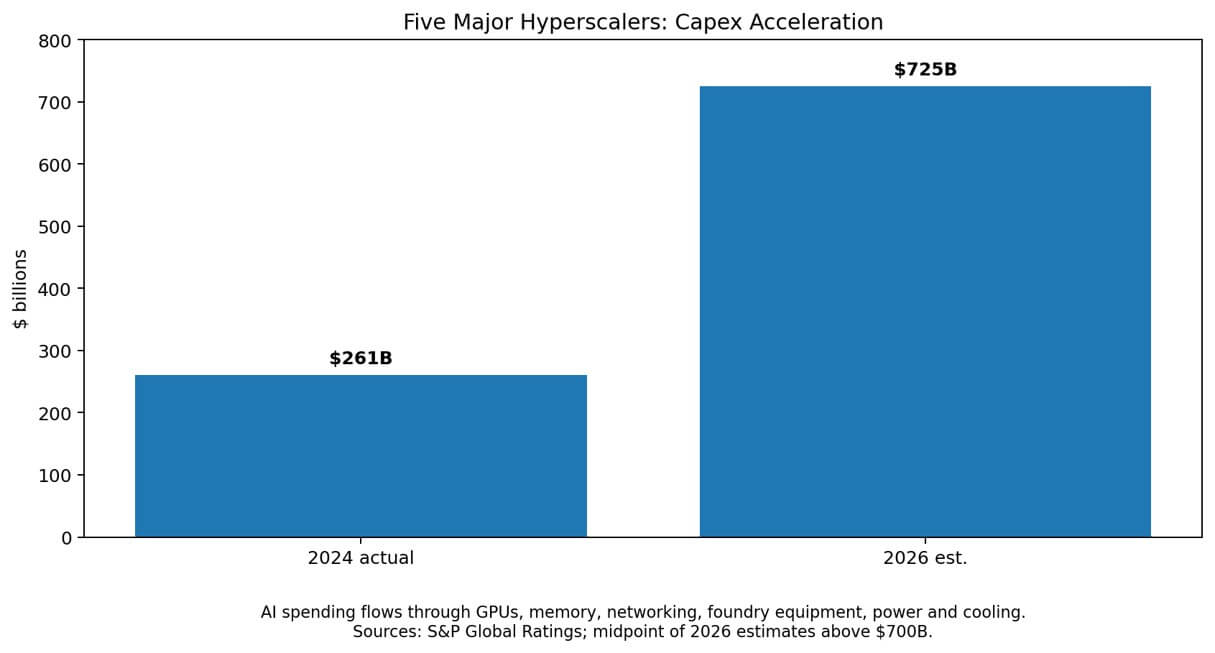
Capex acceleration. Follow with a semiconductor value-chain animation: GPU -> memory -> packaging -> networking -> power/cooling.
HOW THE DOT-COM BUBBLE BROKE, AND WHY TODAY RHYMES
The dot-com bubble did not break because the internet was fake. It broke because the price of the future became too high, while the cost of money rose and liquidity tightened.
The Fed reaction to LTCM blowing in early October of 1998 was the Federal Reserve cut rates and markets exploded higher. Then once again the economy was flooded with liquidity at the end of 1999 due to the fear of a Y2K shutdown. But in early 2000, after the threat of a global financial shutdown caused by Y2K had passed, the Fed reversed course. Short term interest rates rose. The dollar remained strong. Oil climbed from the depressed levels of 1998. Inflation pressures returned with a lag.
At the same time, by 1q200, technology valuations became detached from realistic cash flows. Cisco traded at nearly 100 times earnings. Many companies had no earnings at all. When investors finally demanded profits, the marginal buyer disappeared, IPO demand weakened and the entire financing loop reversed.
Now look at 2026. The economy is still expanding, capital investment is strong, and AI demand is real. But inflation remains above target. The Fed has held its policy rate at 3.5 to 3.75 percent while the 2 year treasury is now over 4.25% and the 10-year Treasury has moved back near 4.75 percent. Oil and Middle East risk have lifted energy inflation. The dollar has rebounded as a safe haven and because U.S. yields remain high and our economy is more stable than most.
That combination – higher oil, a firmer dollar, elevated long rates and less room for the Fed to ease – is an important rhyme with 1999 and early 2000 here in the 2h2026.
But all is not horrible news or set in stone for an AI bust. The differences are just as important.
Today’s largest AI companies generate real revenue, real earnings and enormous operating cash flow. Nvidia is not Cisco at 100 times earnings. The leading hyperscalers can fund much of the buildout internally, and major private companies such as OpenAI and Anthropic keep part of the financial speculation outside public markets. Yes, our biggest companies are moving from pristine balance sheets to debt borrowers. This is a real risk issue. Debt is always a claim above your equity capital.
However, strong cash flow does not make valuation irrelevant. It changes the risk. The danger today is not hundreds of public companies with no business model. The danger is that profitable companies spend so aggressively that free cash flow falls, debt rises and the return on the next data center is lower than investors expect.
The dot-com cycle broke when capital became expensive and investors stopped rewarding growth at any price. The AI cycle would be vulnerable to the same basic mechanism: rising real rates, high oil, a stronger dollar, slower earnings revisions, weaker semiconductor orders and declining confidence in capex returns.
WHAT RETIREES SHOULD WATCH
For retirees, near-retirees, and all investors watch four indicators.
One: semiconductor orders and inventories. The stock market usually turns before the factories do.
Two: hyperscaler free cash flow. Revenue can grow while shareholder cash generation deteriorates.
Three: the 10-year Treasury and the dollar. If both rise together, which they currently are, financial conditions are tightening for global growth and long-duration technology stocks. On the “good/bad” scale this is bad as it lowers PE’s.
Four: leverage and credit. A stock correction is normal. However, forced selling by a leveraged owner can turn a correction into a liquidity event. We saw the second of those last month with the liquidation of public positions in the “Situational Awareness” fund. The first, the rapid liquidation of Silicon Valley bank March 8-10, 2023, about 3 years ago.
CLOSE – GREAT TECHNOLOGY DOES NOT REPEAL FINANCE
The internet changed the world. AI will most likely change it even more.
But great technology does not repeal the rules of finance.
Alberto Vilar and Leopold Aschenbrenner both saw major technology shifts early. What broke was not necessarily the vision. What broke was the portfolio structure around the vision.
The same is true for the broader market. The AI buildout can remain powerful while individual stocks, semiconductor orders and overleveraged investors suffer painful declines.
Participate in the opportunity. Respect valuation. Watch cash flow. And never let one theme – no matter how brilliant – control your retirement future. I guess the lesson here, is regardless of your investment style or economic outlook, every investor should be “situationally aware” of their individual financial plan and its ability to my your own needs, over greed’s, in the future.
Do you need a retirement plan that goes beyond allocating funds to truly fit your needs? We can help you create a retirement life plan customized for your retirement vision and legacy. Call us at 877-896-0040 or fill out this form for a free visit: https://click2retire.com/lets-connect
Chris Perras
CFA®, CLU®, ChFC®
Chief Investment Officer, Financial Advisor
Chris is a seasoned investment professional with over 25 years of experience working with some of the most successful money management firms in the world. Chris has made it a point in his career to adapt as the market landscape changes, seeking to utilize the appropriate investment strategy for a given market environment. His transition from managing billions of dollars at the institutional level to helping individuals and families retire is guided by a desire to see first-hand the impact he is making in the lives of clients at Oak Harvest.
Click to subscribe: