

Dot-Com vs. AI Cycles: Interest Rates Up, Stocks Up. Stock Talk Update, September 18, 2026
Have We Seen This Movie Before?
THE THREE MAJOR POINTS
| 1. Rates | 2. Fed policy | 3. Earnings + productivity |
| High rates did not stop the Internet boom – and have not stopped the AI boom. | Both cycles saw the Fed tighten, then ease, while stocks kept advancing. | Earnings and productivity can overwhelm P/E pressure from higher rates. |
OPEN – “BUT INTEREST RATES ARE TOO HIGH!”
Welcome to Stock Talk. Last week, we made the optimistic case that maybe when comparing the current AI cycle with Dot.com, we are looking at the right movie – the dot-com cycle, but the wrong scene.
Maybe this is not March 2000. Maybe it is closer to the summer or late 1998. Given all of the recent headline news on interest rates globally, this week, let’s tackle one of the biggest arguments against that idea. I hear it all the time: “Stocks cannot keep going higher because interest rates are too high.”
Really? Because long term interest rates in the US and globally have been rising for the last few years, and stocks have been enjoying >10% annual gains. Investors, something very similar happened during the early years of the Internet boom. Interest rates were high. The Federal Reserve tightened. Bond yields moved all over the place. And yet stocks kept going up.
So today I want to compare the first three-and-a-half years after two major technology launches: Netscape – December 19, 1994. And ChatGPT – November 30, 2022. And we are going to keep it simple. Three points: One, higher interest rates did not stop either tech cycle at first. Two, in both cycles the Fed changed policy direction, but the economy and stocks kept growing and appreciating. Three, stocks survived higher rates for the same reason they may survive them today: earnings and productivity.
POINT ONE – HIGH RATES DID NOT KILL THE INTERNET BOOM
Let’s go back to December 19, 1994. Netscape launches. The browser world of the internet begins. And look at interest rates. They were not low. They were very high. On Netscape’s launch date, the 2-year Treasury yielded about 7.6% and the 10-year yielded about 7.8%. Today, we think a 5% 10-year sounds scary. Investors in late 1994 were staring at almost 8%. At ChatGPT’s launch, the picture was different. The 3-month Treasury was about 4.4%. The 2-year was also about 4.4%. But the 10-year was only about 3.7%.
That was an inverted yield curve. The bond market was basically saying: “The Fed is tight. Something may break.” Remember all those calls a few years ago for a 50%+ recession risk? How doomsday an inverted yield curve was?
VISUAL 1 – FOUR-RATE YIELD CHART
| Rate | Netscape launch 12/19/94 | ChatGPT launch 11/30/22 | Sept. 11, 2026 |
| 3-month | ~5.75% | 4.37% | 4.00% |
| 2-year | 7.59% | 4.38% | 4.56% |
| 10-year | 7.81% | 3.68% | 4.95% |
| Fed funds | ~5.50% | 3.75%-4.00% | 3.50%-3.75% |
And yet look what happened to stocks. On December 19, 1994, the S&P 500 was about 458 and the Nasdaq Composite was roughly 728. 3.5 years later, in June 1998, the S&P 500 was around 1,100 and the Nasdaq was around 1,780. That is roughly a 140% gain for the S&P 500 and a 145% gain for the Nasdaq – before the biggest part of the Internet mania even arrived.
Now look at ChatGPT. The S&P 500 closed at about 4,080 on November 30, 2022. By September 2026, it was roughly 7,650 – close to a 90% gain despite higher trending long-term rates. So here is the 1st lesson: stocks do not need low rates. They need earnings growth high enough to overcome those interest rates.
VISUAL 2 – S&P 500 / NASDAQ LAUNCH COMPARISON
VISUAL 1 — Bespoke page 13: Nasdaq Composite after Netscape launch vs. ChatGPT launch. Launch dates, 944-day returns, and the March 2000 endpoint.
| Nasdaq Composite | Netscape Cycle | ChatGPT Cycle |
| Launch | 12/19/1994 | 11/30/2022 |
| First 944 days | +128.5% | +141.1% |
| Relative point in cycle | ~Sept. 1998 | ~Sept. 2026 |
| Final dot-com peak | 3/10/2000 | ??? |
POINT TWO – THE FED CHANGED DIRECTION IN BOTH CYCLES
Here is where the story gets really interesting. The Fed was already tightening when Netscape launched. During 1994, it raised rates aggressively. By late 1994, Fed funds had reached about 5.5%. Then in February 1995, the Fed raised again to about 6%. But then something changed. The economy cooled just enough. Inflation behaved. And the Fed started cutting.
It cut rates in July 1995, again in December, and again in January 1996. Then in March 1997 it raised once. By mid-1998, Fed funds were roughly 5.5%. Think about that. During the first three-and-a-half years of the Internet boom, the Fed raised rates, then cut rates, then raised again. And stocks still soared.
Now look at AI. When ChatGPT launched in November 2022, the Fed funds range was 3.75 to 4.00%. The Fed was not finished. It kept hiking, and by July 2023 Fed funds reached 5.25 to 5.50%. Then the Fed eventually reversed course. Beginning in September 2024, it started cutting. By December 2025, the rate was down to 3.50 to 3.75%.
Sound familiar? Not identical levels of course. But similar paths.
| Internet cycle | AI cycle | |
| Technology launch | Netscape 12/19/94 | ChatGPT 11/30/22 |
| Fed already tight? | Yes | Yes |
| Further hikes after launch? | Yes | Yes |
| Fed later cut? | Yes | Yes |
| Stocks continued higher? | Yes | Yes |
THE YIELD CURVE TELLS AN EVEN BETTER STORY
There is actually a major difference between the two cycles. And I think it is important not to hide it.
In December 1994, the Treasury curve was steep: 3-month bills around 5.75% and 10-year bonds around 7.8%. That is about a two-point positive slope. By June 1998, the curve had become almost flat.
Today’s cycle started the other way around. It started inverted. And now it is becoming positively sloped again. As of September 11, the 3-month Treasury was about 4.00%, the 2-year about 4.56%, and the 10-year about 4.95%.
So the curve has gone from saying “recession risk” toward saying “growth may be stronger – and inflation may stay higher.” That is not automatically bad for stocks. But it is a warning that the long end of the bond market matters more now.
POINT THREE – EARNINGS ARE BEATING THE BOND MARKET
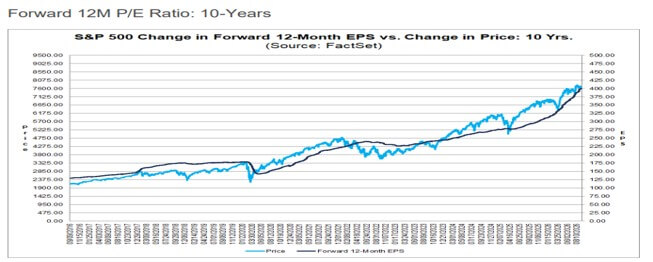
This is the heart of today’s Stock Talk. Why were stocks able to rise during the Internet boom despite high interest rates? And why are stocks doing it again? Because the economy was getting more productive – and earnings were growing. That is Ed Yardeni’s Roaring 2020s argument. Yardeni says today’s bull market is being driven by what he calls FEMO: Fabulous Earnings Momentum.
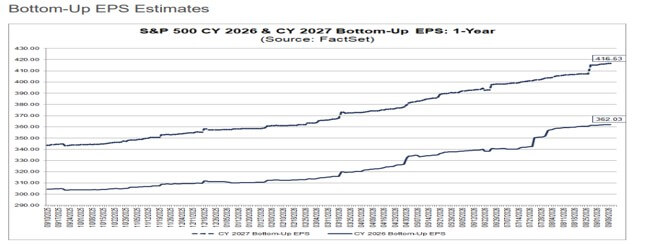
FactSet and Yardeni’s work show S&P 500 earnings growth remains extremely strong. Even stripping out one-time gains, growth remains well above normal, with analysts looking for continued double-digit growth into the second half of 2026. That is not recessionary earnings. That is expansion.
PRODUCTIVITY IS THE BRIDGE
And here is why this could continue. AI spending is businesses buying servers, software, data centers, semiconductors, and new tools for workers. Yardeni’s Roaring 2020s thesis says the payoff comes when technology lets workers produce more in the same hour. That is productivity. Higher productivity can produce more GDP, higher wages, higher profit margins, and less inflation for each dollar of growth.
That is how you get a Roaring 20s economy without needing 1 percent interest rates.
| Higher rates | Productivity / earnings response | Possible stock outcome |
| P/E pressure | Higher sales + margins | EPS growth offsets compression |
| Higher hurdle rate | More output per worker | Stocks can still rise |
| Bond competition | Stronger cash flows | Quality leadership broadens |
THREE REASONS THE RATE STORY STILL LOOKS CONSTRUCTIVE
REASON ONE – HIGH RATES DID NOT STOP THE LAST TECHNOLOGY BOOM
The 10-year Treasury was almost 8% when Netscape launched. Stocks still exploded higher. Interest-rate direction matters, but earnings matter more.
REASON TWO – BOTH FED CYCLES HAVE BEEN TWO-WAY STREETS
The 1990s Fed tightened, then eased, then tightened again. Today’s Fed hiked dramatically, then cut. The key question is not whether the Fed hikes once. It is whether the Fed tightens enough to break earnings.
REASON THREE – THE FUNDAMENTALS ARE STILL GETTING BETTER
The markets bullish case does not require valuations to explode. It requires a resilient economy, improving productivity, and rising earnings. This is healthier than a bull case built only on falling rates.
CLOSE – DO NOT WATCH JUST THE FED
So here is this week’s takeaway. Most investors are staring at the Federal Reserve. Will Warsh hike? Will he hold? What happens to the 10-year? Those things matter. But they are only part of the equation. The other parts are what companies earn, does productivity increase.
History gives us an important lesson. From Netscape’s launch through the first three-and-a-half years of the Internet cycle, interest rates stayed high. The Fed moved both directions. The yield curve changed dramatically. And yet the S&P 500 roughly more than doubled. The Nasdaq did too.
Why? Because productivity improved, economic growth remained strong, and earnings kept climbing.
Today’s AI cycle may be doing something similar. The Fed has already taken rates above 5%. It has already cut them. The 10-year Treasury moved from about 3.7 percent at ChatGPT’s launch to almost 5% today. And yet the S&P 500 is dramatically higher. That is the part I think investors are missing. Higher rates have not stopped the bull market. They simply raised the hurdle. And so far, earnings have cleared it.
So do not watch only the Fed’s next move. Watch earnings. Watch productivity. And watch whether the economy can keep growing despite a near-5% 10-year Treasury. Because if it can, the lesson from the 1990s may not be: “The bubble is coming.” It may be: “The boom still has time.”
FINAL PRODUCTION VISUAL – TWO CYCLES
| Netscape cycle | ChatGPT cycle | |
| Launch | 12/19/1994 | 11/30/2022 |
| 10Y at launch | 7.81% | 3.68% |
| Fed tightened after launch | YES | YES |
| Fed later eased | YES | YES |
| S&P first ~3.5-4 yrs | ~+140% | ~+88% to Sept. 2026 |
| Nasdaq first ~3.5-4 yrs | ~+145% | Strong triple-digit gain |
| Earnings/productivity | Accelerating | Accelerating |
| Cycle ending? | No – 1998 | ??? |
SAME MOVIE. DIFFERENT SCENE?
SELECTED SOURCES / PRODUCTION NOTES
- Prior Stock Talk: September 11, 2026, “The Optimist” – launch-to-launch framework and Bespoke analogue.
- Federal Reserve H.15 Selected Interest Rates – Treasury yields through September 11, 2026.
- Federal Reserve historical FOMC / federal funds data – 1994-1998 and 2022-2026 policy path.
- Ed Yardeni / Yardeni QuickTakes – Roaring 2020s and Fabulous Earnings Momentum framework.
Chris Perras
CFA®, CLU®, ChFC®
Chief Investment Officer, Financial Advisor
Chris is a seasoned investment professional with over 25 years of experience working with some of the most successful money management firms in the world. Chris has made it a point in his career to adapt as the market landscape changes, seeking to utilize the appropriate investment strategy for a given market environment. His transition from managing billions of dollars at the institutional level to helping individuals and families retire is guided by a desire to see first-hand the impact he is making in the lives of clients at Oak Harvest.
Click to subscribe: