


Scary Things That Keep Me Up at Night | Stock Talk Podcast
I get asked almost weekly, “Chris, what scares you about the financial markets? Chris, what is your biggest worry about the future in the capital markets? What keeps you awake at night? Is there a black swan out there? To which I almost always reply, “I worry about everything; that’s why I am bald. It’s part of any CIO or portfolio manager’s job, worrying for our clients.” However, when pressed, I do have a lingering concern about the Federal Reserve balance sheet that many people have yet to discuss. I am Chris Perras with Oak Harvest Financial in Houston, and welcome to our weekly stock talk podcast. Before we get into this week’s topic titled “The Federal Reserve’s balance sheet, what keeps me awake at night.” Please take a moment to click on the subscribe button and click on the notification bell so you will be alerted when our team uploads our latest content. We’ve covered the Federal Reserve’s balance sheet and its expansion and contraction for over three years now at Oak Harvest. We’ve discussed numerous times its apparent beneficial impact during expansions on asset prices and the general difficulty “risk assets” have had during periods of portfolio runoff and shrinkage. While equities have struggled in the past, they still have eventually been able to hit new all-time highs. Case in point, the Fed’s balance sheet shrunk throughout 2018 and 2019, and it was a tough road filled with volatility, but the markets still made new all-time highs. Take a look at the Fed balance sheet versus the S&P500 from the St. Louis Federal Reserve Board’s website. The explosion in the Fed’s balance sheet, under QE4, or the fourth round of Quantitative Easing, which was a monetary program used to offset the Covid lockdowns, is apparent on the graph. Post Covid, the Feds balance sheet expanded from $3.8 Trillion, or about 15-18% of GDP pre-Covid in March 2020 to a peak of around $8.9 Trillion a few weeks ago, which is about 36-38% of GDP. The Fed and other…
Opportunity Knocks Pt 2 Stock Talk
The Oak Harvest team hopes you had a fun and safe 4th of July weekend. We wanted to start off the second half of 2022 on a positive note. So here amongst the slowing economic data and bad news on TV, here’s a table from JP Morgan showing the opportunity cost on investing of waiting until the ski’s clear and the government data confirms that the coast is clear, and GDP is growing again. Let this data sink in. We’ve reviewed many of these prior periods already on prior podcasts to compare the stock market, economy, and election cycles. But these numbers should jump out at you. The stock market bottoms on average 116 days before government data tells you that the bottom in GDP has happened. That’s almost 4 months. In those 4 months the average return of stocks has been around 21%. If you sit back and wait until the government economists tell you the economy is back growing, and GDP is turning up again? On average, you missed another 10% gain on top of the initial 21% gain for a total average recovery of almost 32%. 32%? That’s quite a bounce. Positive 32%, on average, before the much watched, and often quoted government data tells you the coast is clear. The Oak Harvest team tries to stress that by the time government economic data is reported, its backward looking and stale. Opportunity knocks, almost always, when markets are more uncertain than normal, and when market volatility is high not low. Your highest returning investments will almost always come from those investments you make during economic slowdowns or recessions. When GDP growth is nonexistent or negative. Your highest returning, long-term, investments almost never come from investing during economic boom times. I am Chris Perras with Oak Harvest Financial in Houston and welcome to our weekly stock talk podcast. Before we get into this week’s topic titled “Opportunity knocks part two”. And before we talk about what might be the most important chart and data series to both the…
Opportunity Knocks Early! | Stock Talk Podcast
The Oak Harvest team wants to wish you a happy, safe, and blessed 4th of July weekend as this video should be going to publication just in front of the holiday. Opportunity knocks, almost always when markets are more uncertain than normal and when market volatility is high, not low. Your highest returning investments will almost always come from those investments you make during economic slowdowns or recessions, not during economic boom times. Now that the S&P500 has joined the Nasdaq and has officially entered a bear market, should you raise cash? Or, now that Asset manager positioning, which is contrarian bullish, is beginning to flash a buy signal not seen since 2016 and 2011, should you marginally add to your investment holdings if you can. Is it time to dump technology stocks, or would it be better to add some back? Take a look at the 20-year chart of the NASDAQ composite since the internet bubble bottom in 2002. The relative performance of the Nasdaq comp is now back to its 20-year trend line, and the index has found support on its 50-month moving average for only the 10th time in 20 years? Are you a buyer or seller of growth and tech stocks down here? Think of your investment returns since the recession in 2008/09, or even since the Covid recession in early 2020, if you didn’t panic and you didn’t reallocate away from stocks at that time? You didn’t eject during those periods of elevated economic uncertainty. Think about how much better your incremental returns would have been if, instead of withdrawing from the markets and trying to hide short-term while markets were already down, you had instead added marginally to your holdings? I am Chris Perras with Oak Harvest Financial in Houston, and welcome to our weekly stock talk podcast. Before we get into this week’s topic, titled “Opportunity knocks,” please take a moment to click on the subscribe button and click on the notification bell so you will be alerted when our team uploads our…
REITS-the Real deal about Real Estate Trusts
We first covered the topic of REIT investing, or real estate investment trusts, a little over two years ago, right after the March 2020 Covid market fall. Given our recent News or Noise video on “dividends matter,” I wanted to take this video as an opportunity to walk you through REIT investing and what you should and should not be looking for if you are out there picking your own stocks and searching for dividends. I am Chris Perras with Oak Harvest Financial Group here in Houston, Texas, and welcome to our weekly stock talk podcast. Before we get into this week’s topic on “REIT Investing,” please take a moment to click on the subscribe button and click on that notification bell so you will be alerted when our team uploads our latest content. Retirees and many others nearing retirement, love dividend stocks because they can help provide current reoccurring income through their cash distributions. Many investors gravitate toward owning some publicly-traded REITs or Real Estate Investment Trusts. I’m going to provide what I hope is an eye-opening educational lesson for investors in REITs. I’m doing this mainly because these investment vehicles have become an enormous investment category in the last 20 years, as baby boomers have desired investment vehicles that provide income for retirement. With government interest rates low over the previous 15 years, money has flocked into real estate by way of mutual funds, single stocks, and ETFs. Public REITs account for around $2.5 trillion in assets spread amongst over 225 public companies. Private REITs account for almost $1 trillion. Combined, this $3.5-trillion industry has become massive. The asset class that most of my comments here are directed specifically at is publicly traded, single stock, listed REITs. First off, what is the definition of a REIT, or a real estate investment trust? Here’s the definition, and please listen carefully. They are companies that own, and this is very key to today’s story, or they finance income-producing real estate across a single or multiple property sectors. REITs allow investors…
Should You Buy Into SuperCycles in the Stock Market | Stock Talk Podcast
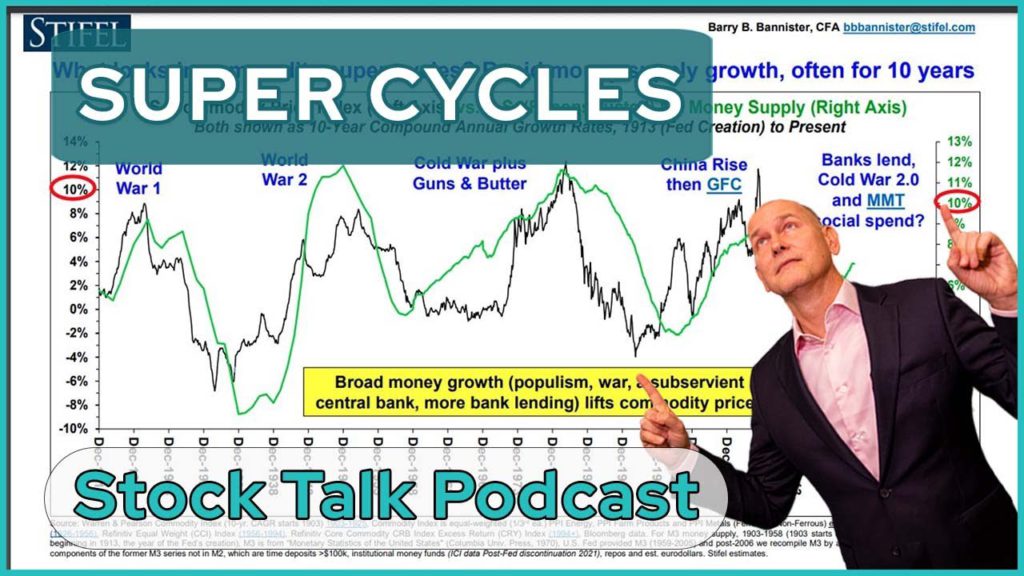
Why analysts and the financial press love the term “super-cycle,” I can only guess. I guess it is used to relay the idea that you can buy anything in the group or industry at any time and you’ll make money. It’s most commonly used when referring to commodities, but over the last 20 years, it has made its way into the general lexicon of virtually every S&P500 sector. Remember the semiconductor “super-cycle”? Or the biopharma “super-cycle”? How about the “fertilizer” super-cycle? I recall hearing on TV from several food analysts that “People have to eat.” Did you forget about the “agriculture” super-cycle? Or the plant-based protein “super-cycle? The “EV,” electric vehicle super-cycle? I could list another 5 or 10 I’ve heard about in the last ten years, and guess what? None of them were very “super” by the time that term was thrown around to describe them in public equity markets. I am Chris Perras with Oak Harvest Financial in Houston, and welcome to our weekly stock talk podcast. Before we get into this week’s topic on “super-cycles,” please take a moment to click on the subscribe button and the notification bell so you will be alerted when our team uploads our latest content. Super-cycles; We hear the term thrown around all too often on TV and in newsletters mainly as a way of trying to message investors that the coast is clear and you can buy stock in the “super-cycle” deemed group and make money. I’m not going to address all of the prior anointed super-cycles in industries outside of commodities because whenever I hear that term in the press, my first instinct is to sell everything in the anointed group, run and hide from the sector and never look back for years. Commodities, like other sectors, usually move in bull and bear market cycles. Historically, these moves have been much more consistent and predictable in commodity groups than in many other sectors in the stock markets. Why? Because the capital expenditures needed to expand supply in major ways…

Taper Tantrum 2.0 | Stock Talk Podcast
On June 1st, The Federal Reserve officially began its second try this decade at “Quantitative Tightening” programs. This is also referred to as “QT.” Recently, a lot of noise has been made that this might be disastrous for the financial markets over the next 6 to 12 months. The first time the Fed went down this path was in 2013 and 2014. We want to review the specifics of the current QT timeline and refresh investors memories on what happened when the Fed went down this path nearly a decade ago. Call this video Taper Tantrum 2.0 and what it might mean for your portfolio; historically, it’s not what you think. I am Chris Perras with Oak Harvest Financial Group, here in Houston, Texas, and welcome to our weekly stock talk podcast. Before we get into this week’s topic on the Fed balance sheet tapering and what it might mean to your investments, please take a moment to click on the subscribe button and click on the notification bell so you will be alerted when our team uploads our latest content. This week’s topic is to help address the recent concerns around what might happen to the markets as the Federal Reserve starts its new quantitative tightening program. Recall Quantitative tightening, or QT, is just a fancy term for the Federal Reserve not buying Treasury bonds and mortgage bonds. Instead of buying assets to stabilize markets, the Federal Reserve will be letting these assets run off their balance sheet and back into the markets. While they are not directly selling bonds into the market yet, we are essentially removing a massive buyer from the fixed-income markets. Remember, this buyer has been present each and every week since they reinitiated this program as part of the emergency measures enacted to kick start the economy and markets from a covid recession in the second quarter of 2020. The central bank’s balance sheet has roughly doubled in size during the coronavirus pandemic as it purchased both Treasuries and mortgage-backed securities to smooth market…
Your Recession Guide For 2022
Almost exactly a month ago, our team released a “News or Noise” YouTube video titled “Negative first quarter 2021 GDP Growth, Is a recession coming?” We did this video because on April 29th, the Commerce Department, which is the government agency that calculates this data, released first quarter real GDP growth figures saying our economy actually shrunk by -1.4% in the first quarter, versus economist expectations of a positive +1%. We figured that this would kick off the non-stop media discussion of whether we would have a recession in 2022 or 2023 or ever again. I am Chris Perras with Oak Harvest Financial in Houston and welcome to our weekly stock talk podcast. Before we get into this week’s topic on the recessions and the stock markets, please take a moment to click on the subscribe button and click on the notification bell so you will be alerted when our team uploads our latest content. This week’s topic is to help address the ongoing headline stories of a weak economy, negative GDP growth in the first quarter, or a looming recession. First off, I will continue to remind investors that government data is reported late, is often revised multiple times, and is almost never predictive to the economy or stocks. Think about it, by the time that negative GDP quarter was reported in late April, the S&P500 was already down over 14% from its December all-time high and sitting around 4135. Conversely, by the time the data scientists in government declare a “recession”, most of the time, the markets have discounted most if not all of the bad news, have healed to a large degree, and recovered much if not all of their losses as they are already looking forward to the next 12 months and easy comparisons in growth rates. Our prior podcast walked through how GDP growth is calculated. In it we detailed how the surge in import volumes in first quarter of this year led to our negative GDP print. We also discussed how terribly difficult the…
Summer Slowdown | Stock Talk Podcast
Two weeks ago, our weekly podcast was titled “nowhere to run to, nowhere to hide”. In it, we discussed the fallacy behind the notion of “hiding out” or trying to “hide out” in certain stocks or sectors during market corrections, bear markets or general economic slowdowns. We argued against the notion that there is “always a bull market out there” as discussed on TV by a few hosts. Unless you are running a hedge fund, that’s generally not how the markets or portfolio management works for the masses or most institutions. I am Chris Perras with Oak Harvest Financial in Houston and welcome to our weekly stock talk podcast. Before we get into this week’s topic on the summer slowdown but looking for second half hope, please take a moment to click on the subscribe button and click on the notification bell so you will be alerted when our team uploads our latest content. Earnings season is winding down but last week a few large well-known companies in the consumer space dropped earnings bombs on the market. In the span of a few days, Walmart, Home Depot, and Target all reported their first quarter earnings. While Home Depot reported higher than expected revenue and earnings, both Walmart and Target missed earnings and margin estimates by wide margins. What happened? Exactly what we were afraid of in the late 4th quarter of last year, but in a much worse manner. Call it the perfect storm for retailing. The short story is this. Companies ordered goods for the second half of 2021. They did this into the Christmas 2021 selling season to restock their shelves that were pretty bare from the consumers buying during the Covid induced stimulus programs in the second half of 2020 and first half of 2021. Unfortunately, much of this inventory was stuck off the coast of California in containers for months when demand was strong. Ultimately, most of these larger items were delivered after the Christmas shopping season and restocked on the shelves, with these retailers having…

What does the Movie Top Gun have to do with Your Retirement Investments?
So, the sequel to one of my favorite movies of all-time comes out in a few days. It’s been more than a 25 year wait for the sequel to the 1986 hit movie “Top Gun”. Its sequel Maverick will be released on May 24th. Here’s a link to the movie trailer in the description below. The timing of the Top Gun, Maverick movie release couldn’t come at a more exciting time in the life of the Perras family. You see, I am super proud of my two sons, Kyle and Aidan, who have now both graduated from Georgia Tech with the highest honors. Just two weeks ago, my younger son Aidan graduated with a perfect 4.0 GPA with a major in Industrial Engineering. Georgia Tech has had the number one ranked school in the nation in Industrial engineering for decades. Yes, it’s ranked in front of the likes of Stanford, MIT, and other renowned engineering schools. Yet instead of taking his 4.0 grade point average in Engineering into the private sector, he has instead been commissioned into the Navy as an Ensign. Here’s a picture of him being sworn in in Atlanta. The kicker? He has been accepted into the Navy’s flight training program, and he will be reporting to Pensacola shortly to begin Naval flight school. One day down the road, he hopes to protect me, you, and your rights from the skies above. I am Chris Perras with Oak Harvest Financial in Houston, and welcome to our weekly stock talk podcast. Before we get into this week’s topic on financial planning and continued recent market volatility, please take a moment to click on the subscribe button and click on the notification bell so you will be alerted when our team uploads our latest content. The first half of 2022 has not been fun for anyone, Including our investment and financial advising teams here at Oak Harvest. We had expected a 1st half market correction and high volatility. We laid out this scenario back in November of last year. …

2022 Stock Market Volatility |Nowhere to Run, Nowhere to Hide | Stock Talk Podcast
Market correction in the S&P500 and “bear market” in the Nasdaq Composite, emerging markets and small caps, and the markets tune is playing the Martha and Vandellas tune, Nowhere to Run to, Nowhere to Hide. I am Chris Perras with Oak Harvest Financial in Houston and welcome to our weekly stock talk podcast. Before we get into this week’s topic on market volatility, please take a moment to click on the subscribe button and click on the notification bell so you will be alerted when our team uploads our latest content. First off, the first half of 2022 has not been fun for anyone, Including our investment and financial advising teams here at Oak Harvest. And that is with our team having expected a 1st half market correction and high volatility. We first laid out this scenario back in November of last year. Even so, this is not enjoyable for anyone short term. Bond market volatility has caused fixed income losses which then spread to equity markets and create volatility there and elsewhere. We have discussed the notion of collateral damage amongst leverage asset managers multiple times the last 4 years and its effect on the rest of us who invest unlevered, in equities for their longer term, measured in years, positive returns versus fixed income. Last week was a case study in the perils of leveraged investing. In the span of less than 24 hours after Wednesdays Federal reserve meeting, the S&P500 gained +125 points and then lost -200 points. Virtually in straight lines. How can this happen you ask? Leverage. For whatever reason, the Federal Reserve meets and releases their statements in the afternoon when only one major market in the world is open, the markets here in the United States. So, post Fed meetings, computers, and anyone else in the world who wants to trade short term around this event have few alternatives, here in our markets. This seems to do little more than create massive, short-term volatility which traders love, and long-term investors despise. Come Thursday,…