

2026 Surprise of the Year? Stock Talk Update, Friday February 13, 2026
Like many other advisory groups, the team here at Oak Harvest likes to release our market outlook for the year. Our team has historically split the year into the first and second half as things can change rapidly as we saw in late1q25. This year’s release was titled “Being a Bull Rider is Harder Some Years”. We laid out 2 positives and 2 negatives we saw that might affect stock market returns while producing higher volatility in 2026 than in prior years. The bullish tailwinds and arguments for 2026 stock returns center around S&P500 earnings and earnings growth rates throughout the year. Large and accelerating AI capex investments by the largest market cap companies, helpful tax policies within the BBB, big beautiful bill, from a business accelerated deprecation standpoint, consumer tax refund and cash flow tailwinds set the overall S&P 500 up for high and accelerating quarterly EPS from 1q-4q through 2026. Add in a likely more dovish Federal Reserve and or Treasury department come the 2nd quarter. Historically, 1q EPS are the low bar for quarterly earnings in the US for the year. Currently bottoms up, FactSet’s EPS forecasts have 4q26 quarterly earnings expectations of about $83.34/s up over 13% yty from the quarter we are in right now. While this is a touch lower than projected 17% growth a few months ago, this “slowdown” in growth rate is entirely due to 4q25 EPS coming in significantly higher than projected just a few months ago. This higher base rate in EPS for 4q25 would make the 4q26 comparable growth rate at up over 13% slightly lower off a much higher base. The two negative themes for 2026 were the normalcy of higher sustained volatility due to it being a second year of a presidential term, mid-term election cycle and at some point, the markets likely testing the new Fed Chairman within the first year of his sitting term. We ventured to guess it would be over a shock of sustained higher inflation prints. Our team usually also gets the…
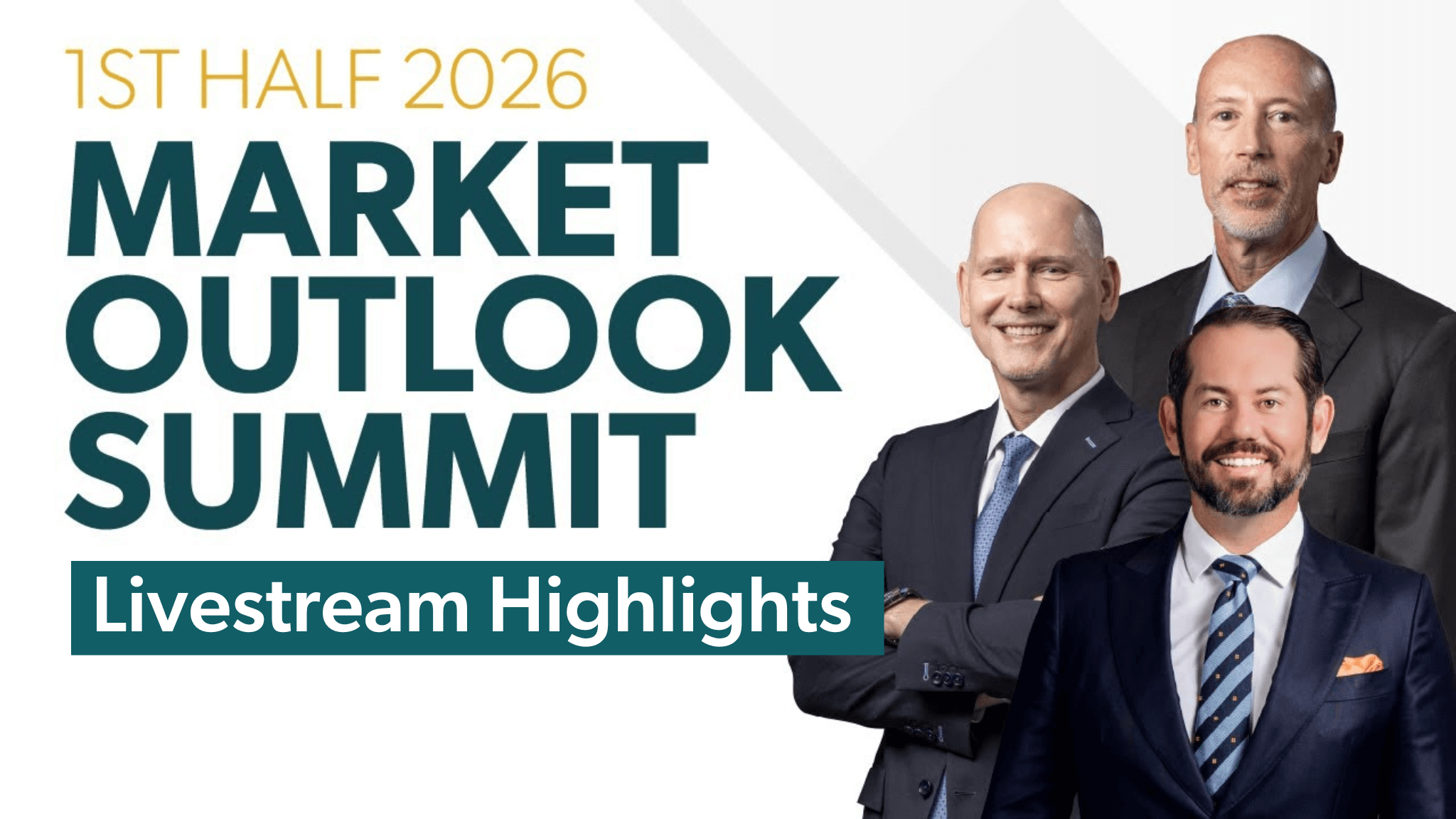
1H2026 Market Outlook Summit Livestream Highlights
Troy Sharpe:We will jump right into 2026. So Chris, I’m throwing it to you first. What is the primary reason that stocks should do well in 2026? Chris Perras:Thanks, Troy. So yeah, we titled this year’s outlook, some years it’s harder to be a bull rider. So we’re positive on the market, but we’re expecting there to be a fair amount of volatility here, particularly in the first half. But the number one positive thing that we see, and this is usually Charles’ point more than mine, is earnings for the overall market look to be good and probably accelerating throughout the year. The first quarter will grow high single digits. By the last quarter, the projections are to be in the 13 to 15 percent range, I think, for the fourth quarter. So throughout the year, earnings accelerating in the S&P 500. We’ve talked about in the past why that’s possible, whether it’s the big, beautiful bill, no tax on tips and tax refunds that are coming in April to help stimulate the consumer, and a lot of capital spending going on here in the United States. That’s a big tailwind for the market for the whole year, starting after we get through kind of the first quarter as things start to improve throughout the year. So that’s the first big one. Troy Sharpe:So when we look at the consumer spending aspect of this, you talk about no tax on tips and some of the aspects of the big, beautiful bill. It’s not going to impact many of you who are retired or about to retire, but why is this important to the people paying attention tonight when they’re concerned about the potential direction of the market? Chris Perras:Yeah, well, it provides lower taxes to a consumer, provides higher tax refunds, so there’s more cash in a consumer’s pocket. And we know most consumers here in the United States, when they have cash, they don’t generally save it, they spend it. So I think the estimates are anywhere between…
1q26 Risks – Inflation Rising: Stock Market Update, Friday January 30, 2026
We spent the first few weeks of 2026 discussing market volatility in our video, both realized actually seen volatility in the markets (low) and implied volatile at that expected by the options markets (high looking out starting mid-February). We talked about our thoughts on what might be a very sloppy, choppy 1q with a pullback possibly between Feb and mid-April. For the 2nd half of 2025, in our videos and at our OHFG educational events, our team messaged that we saw inflation dropping faster than others expected it to. Our rationale back then focused on a few things. First was housing costs, or shelter costs as economists refer to them, which our data said were slowing faster than the government data reflected in their numbers. Here’s Goldman Sachs chart and their forecast on shelter inflation. Given the weakening job market and its forward effect on people moving after changing jobs and given the tighter immigration policies of the last 2 years, Goldman Sachs expects shelter inflation to continue lower toward 2.25% thought 2026 below the 3% shelter costs that prior PCE measures came in at. That’s of course a good thing on the good bad side. The other two large parts of the inflation equation are goods and services each which rose substantially after the reopening of the economy, post Covid 2020 fiscal and monetary stimulus program. We all remember 2022 and the 7-9% inflation prints during that year, don’t we? Here’s Goldman chart on core Goods and Services inflation and it’s easy to see the Matterhorn like inflation ramp in 2021/22 and its slowdown since. On the service side, wage inflation continues to slow as a combination of a weakening job market, layoffs of white-collar workers due to AI, and the productivity gains of AI are helping keep service costs down. That’s a good on the good bad scale. Which leaves the goods side of inflation which according to GS is slated to actually accelerate some here in the 1h26 on the back of tariff pass throughs on new…
Volatility Speaks: Investors were Warned. Stock Market Update, Friday January 23, 2026
Well, that didn’t take long. We discussed the likelihood of elevated volatility in the 1q26 last week, and boom, over the weekend President Trumps re-ramping Tariff restrictions in front of his Davos speech and demanding Greenland concessions from Europe caused an explosion in volatility along with a selloff in long treasury yields on the fear of higher inflation or a greater risk premium for holding USA Treasuries. His threat to impose 10% tariffs on European nations that don’t follow his lead met with outrage across Europe and the rest of the globe. Leaders in Europe planned an emergency plan to discuss tariffs on €93 billion ($109 billion) of US goods. In less than half a trading day, the S&P 500 Index wiped its YTD gain in 2026. Returning from a long MLK holiday weekend, the S&P 500 fell -2.1% Tuesday, its biggest drop since October. Technology stocks were the biggest losers on the day. The Dow Jones Industrial Average dropped -1.8%. The Nasdaq composite shed -2.4%. As we said in our weekend update to start the year, “He’s back”, referring to the Presidents history of Thursday afternoon or weekend tweets and position changes that surfaced in 2018 in his first term 2nd year. Besides the weekend demands of the President, the markets flipped from complacent to volatile with investors bracing for the president’s speech at the World Economic Forum in Davos, the US Supreme Court’s expected decision on the legality of key elements of Trump’s trade agenda, and an announcement of the next Federal Reserve chair. Do any of these items materially change the outlook for earnings in the S&P500 over the next 3-4 qtrs? Given the BBB accelerated depreciation provision? Given the tax law changes that should help consumer cash flow in the 2q? Doubtful. But marginally, they do raise concerns about higher inflation and slower growth which translate into lower valuations. The CBOE Volatility Index (VIX), or “fear gauge,” surged past 20.00 threshold on January 20, 2026, marking a shift in sentiment as many investors new year’s optimism…
Volatility Speaks: Stock Market Update, Friday January 16, 2026
Turn on the financial news and most days you’ll hear someone talk about the markets being highly “volatile” and uncertain and more often than not you’ll also see the interviewer nod in agreement. With 2026 being the second year of the presidential cycle, the dreaded mid-term election year, historically, while posting positive returns, these mid-terms year, like we are in in 2026, have elevated levels of volatility and exaggerated seasonal swings in returns. English language translation? The highs and lows, the ups and downs in the indexes, throughout the year, tend to be wider and have more frequent swings. Some years the market and the returns it generates feel volatile but aren’t mathematically that far off a normal year. Over the last 5 years an investor had to endure a -27.5% peak to trough decline in the S&P500 in 2022 and another Trump Tariff dump of -21% last year in April with over-10% of that coming in less than a week, that’s out of the ordinary volatility. But investors know that the longer term reward for investing in equities is the return. The “risk” is enduring the downside volatility at times. Here’s the data from Charlie Bilieo on annual drawdowns and their frequency. A -5% decline in the S&P500 happens nearly every year, while a -10% decline happens, every 18 months. So, are the markets really more volatile than they have been, or is the financial media guilty of making investors “fee” more volatile? Looking at the data, a bear market decline of -20% happens a little over once every 4 years while a recessionary decline of -30% happens 1 out of 10 years. With these stats in mind, it brings me to this week’s topic, market volatility, what you’re feeling, what’d happenings, and what we are seeing over the next 4-6 months. Let’s stock off talking about bond volatility. I like to follow a measure of Treasury bond market volatility. This is an index we’ve discussed many times in the last 5 years, the MOVE Index. I consider this…
2026 Patience: Stock Market Update, Friday January 9, 2026
Over the last 4 weeks the OHFG has released our thoughts on 2026 and what might be in store for the equity markets. If you’ve been watching our content, you’ll know that our team remains constructive overall on equities for the total of 2026, however we are expecting a heightened level of volatility in financial markets particularly in the 1h of the year. We titled our overall 2026 outlook “in Some Year’s, it’s Harder to Ride the Bull”. Given my love of 80’s rock music and bands, if we have a theme song for our 2026 outlook, it would have to be “Patience”, the 1988 hit by Guns and Roses. Why? Well “Patience” is a rock power ballad about navigating a difficult relationship, emphasizing that love requires time, understanding, and calm, taking it slow sometimes approach, for things to ultimately work out. Sounds to me like a great recipe for investing in most years. Sometimes, on rare occasions, it’s better to act fast and put more dollars to work aggressively, and walk away, as the stars align, the investment opportunities abound and the odds for higher than historic returns are in an investor’s favor. As we discussed in our previous videos, we do not expect the beginning of 2026 to play out as a move fast to invest market. Here’s a repeat of the great data from Charlie Bilieo on annual drawdowns and their frequency. Look at the above chart. -5% decline in the S&P500 happens nearly every year, while a -10% decline happens, every 18 months. The last decline we had of over 6% was back in April of 2025. Those bear market declines of -20% happens a little over once every 4 years while a recessionary decline of -30% happens 1 out of 10 years. What issues, as well as opportunities the Oak Harvest investment team thinks the coming year might present investors. There are times when tactically, the investing odds favor going faster and investing more, and their other times, like going into 2020, that it was time…
Retiring in 2026…Oak Harvest’s 2026 Market Outlook: Part 3 – Dovish Federal Reserve BUT!…
This week’s topic, the 3rd part of our Oak Harvest’s 2026 market outlook. We’ve been doing these forecasts for over 5 years now at Oak Harvest. Our goal is to give our clients and prospects an idea of what issues, as well as opportunities the Oak Harvest investment team thinks the coming year might present investors. There are times when tactically, the investing odds favor going faster and investing more, and their other times, like going into 2020, that it was time to “curb your enthusiasm” and proceed more cautiously. As we’ve seen a few years, like 2017, lack volatility. The bull strolls out of the gate, and your ride is over in 12 relatively uneventful months. An investor looks back at year end and it looks like nothing eventful happened, but your portfolio of stocks gained. However, more often, like 2025, you look back and the markets and your investments endured a few bouts of downside volatility. Most years, even in strong bull markets, the bull tries to buck investors off its back onto the ground. Hopefully an investor ends the year without being gored. Our team is thinking 2026 will likely be one of those more volatile years. We previously discussed the elevated volatility in a mid-term election year like 2026 will be. The gain in a Presidents 2nd year from 1950-2023 period has been only +4.6%, less than half the average annual S&P 500 gain of about 10%. Remember these are point to point returns at the start and end of the year, and they don’t include intra year highs and lows. That is, they don’t include volatility throughout the year. For 2026, throw into the mix it’s a mid-term Presidential election cycle year equation and the markets history of “testing” a new Fed Chairmen during their first term, and investors should be wary late 1q and 2q of 2026. What am I talking about? Well let’s talk about it. Clearly, President Trump is looking to nominate a more dovish Fed chairmen as Powell exits in the…
Retiring Soon? Here’s What the Market May Do in 2026 (Market Outlook: Part 2 – Earnings)
Last week, we began to add some meat to the bones of our 2026 market outlook. Our goal is not to be precisely accurate, but to give Oak Harvest clients and prospects an idea of what issues, as well as opportunities, our investment team thinks 2026 might present investors Last week we covered seasonality and cycles and how they might be both a tailwind beginning in early 2026 but a headwind throughout most of mid-year. Since last week’s I recently discovered another amazing chart on recent Trump Presidential cycles that ill share with you If you hang around until the end. To this week’s topic and video, the most bullish thing the Oak Harvest team can find for 2026? A very strong anticipated 2026 S&P500 earnings and quarterly earnings growth rates. How strong? Let’s talk about it. Currently bottoms up, FactSet’s EPS forecasts have 4q26 quarterly earnings expectations of about $82.5/s exiting the year. Here’s the Fact quarterly data. That 4q26 number would be up over +17% yty from the quarter we are in right now, 4q25. Remember investors, over longer time frames, stocks follow earnings. Here’s a chart from Factset showing that strong trend over time. The good news is that’s a big number and likely attainable. Also historically, unlike market bottoms that anticipate recoveries, the market doesn’t historically peak in front of earnings but rather coincidentally. Assuming, no PE contraction in 2026, 17% growth, on top of the current S&P500 of 6850ish would triangulate to a much higher S&P500 at some point in the 2h2026. How much higher? Well 17% above the 6835 level the S&P was trading at would equate to near 8000 at a peak in 2026. Sounds unachievable? We’ve been up + teens % 4 years in a row a few times over history, including yes, the 1995-2000 Dotcom investment cycle. Interestingly, this path would also mirror the path we took along the Dot.com/AI investment cycle pattern post Long-Term capital in October 1998, that stocks have been in sync since the early April lows. …
1H26 Stock Market Outlook: Part 1 -Cycles and Seasonality
The reward for investing in equities is its return. The “risk” is enduring the drawdowns and market volatility at times. Here’s data we’ve previously shared from Charlie Bilieo on S&P500 drawdowns and their frequency. A -5% decline in the S&P500 happens nearly every year. A -10% decline usually happens, a bit over once every 18 months. A bear market decline, defined as -20%, happens a little over once every 4 years. If you invest long enough, expect at some point during your lifetime, the S&P500 will lose -50% of its value. Given its rarity, let’s call that a generational decline. With these downturns in mind, we are going to add some details to last week’s sneak peek at Oak Harvest’s 1h26 market outlook. This week we are covering seasonality and cycles and how they might be both a tailwind beginning in early 2026 but a headwind throughout most of mid-year. Our goal is not to be precisely accurate, but to give Oak Harvest clients and prospects an idea of what issues, as well as opportunities, our investment team thinks the 1h2026 might present investors. Some years, like 2017, lack volatility. The bull strolls out of the gate, and your ride is over in 8 seconds. An investor looks back at year end and looks at their portfolio and it looks like nothing eventful happened, but your portfolio of stocks gained. More frequently however, like 2025, you look back and the markets and your investments endured a few bouts of downside volatility. Most years, even in strong bull markets, the bull tries to buck investors off its back onto the ground. Hopefully an investor ends the year without being gored. For the early first half 2026, our team is thinking the tailwinds for the current bull market extend, pushing the major indexes higher in early 1q. Historically, late December and very early 1qtr seasonality is positive and on the investors side. Here’s the monthly return data chart from Merrill BAC dating back to 1929. December tends to be a strong positive…
2026 Outlook Preview: Being a Bull Rider is Hard Some Years
Since we exited the Covid lockdown, investors have been treated to a continuation of the bull market that began between 2010-2012 depending on your definition. As of this writing, the cash S&P500 sits around 6850 up about 16.5% year to date. This said, it has not been easy to stay a “bull” and to stay positive and long biased the last 5 years. Over the last 5 years an investor had to endure a -27.5% peak to trough decline in the S&P500 in 2022. Include the near +10% inflation reading that year and that’s, -37.5% in purchasing power declines. In addition to that 2022 earnings “recession” decline, investors more recently had to whether a -21% decline in the S&P500 in April 2025 around the Trump Tariff tantrum. Longer term investors know that if you invest long enough, you will likely endure unrealized losses and downside volatility of varied sizes each and every year if you are invested in the S&P500 or any other index. The reward for investing in equities is the return. The “risk” is enduring the downside volatility at times. Here’s some great data from Charlie Bilieo on annual drawdowns and their frequency. Look at the above chart. -5% decline in the S&P500 happens nearly every year, while a -10% decline happens, every 18 months. The treaded bear market decline of -20% happens a little over once every 4 years while a recessionary decline of -30% happens 1 out of 10 years. Investors, if you invest long enough, expect at some point during your lifetime that the S&P500 will lose half its value. Given its rarity, let’s call that a generational decline. With this in mind, it brings me to this weeks topic, our Oak Harvest’s 1h26 market outlook, or at least a sneak peek. We’ve been doing these forecasts for over 5 years now at Oak Harvest. Our goal in this exercise is not to be precisely accurate, although many of our market forecasts have historically been both pretty accurate as well as precise, but its to…