

Over 60 And You Want Secure Retirement Income Protected from Stock Market Losses?

One of the biggest fears that many people have entering retirement is the fear of running out of income. That’s why many of our clients tell us that they want some portion of their retirement dedicated to generating some type of secure income that’s reliable, it’ll be there for them, and not impacted by the stock market’s ups and downs. From a planning perspective, this helps us out because when we pair a stable source of income with an optimized social security strategy, we create what we call a baseline level of income in retirement. We found over the years that our happiest clients are the ones that have secure income coming in and they don’t worry about what the stock market is doing.
One of the tools specifically designed to accomplish this objective is the Fixed Indexed Annuity with an Income Rider. In this video, we’re going to tell you exactly how they work, and more importantly, how they can be used from a planning perspective to help you generate more secure income in your retirement. There are a couple of things that I really like when a client wants to add an income rider to the Fixed Indexed Annuity or use this tool as part of an overall retirement strategy.
First, it’s pretty straightforward. You make the deposit, you know exactly how much income you’re going to get when you want that income, and you even have the flexibility to, if life changes, to take the income sooner or later, and we’ll go through that in a few minutes. The second thing, though, is from a planning perspective, it makes our job a little bit easier, and honestly, a little bit better, because when we know when something is going to happen in the future, it takes a variable element out of the planning process, and it’s something that we can rely on. It makes our job a little bit easier.
Now, this is something that I believe in personally. It’s something that I’ll add to my retirement plan probably when I hit 50. That way it can grow and compound until I’m 60 or 65, however long I decide to let it grow, and I know that that income source will be there for me in retirement. That’s where we’re going to start with this educational video. We’re going to show you exactly what I mean by pretty simple and straightforward. You make a deposit. Depending on when you want to get income, you know exactly how much that is. Stay with me as I go through this. We’re going to do it in a little bit of a reverse order, but I feel this is the best way to start, because it really emphasizes how straightforward these tools can be for you in your retirement.
Income examples with a deposit of $300,000, 0-5 years deferred
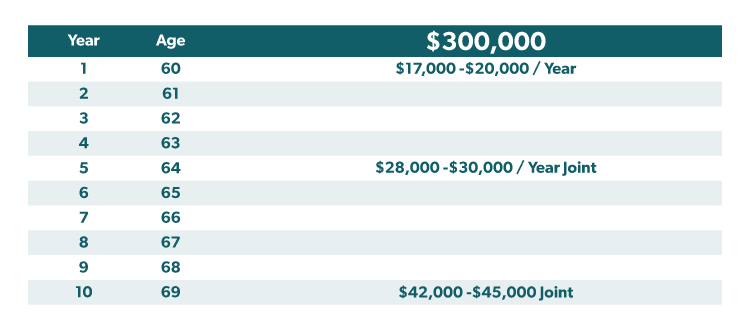
In our example here, we have a deposit of $300,000. We have years of deferral, and then we have a current age and age you will be in the future. Now, rates are always changing. This is a dynamic marketplace. I put some ranges up here based on the age and years of deferral. This means you make your deposit. You want income in one year. You’re 60 years old, you and your spouse. This is the income that would be fully guaranteed. It’s a range because different companies offer different amounts. Some of the contracts have various features and benefits. Some have long-term care benefits, which we’ll cover.
I just want to provide a range of income, because not only can these be customized for your retirement plan, but for your objectives, what you’re trying to accomplish. Very simple, you make a deposit. The life insurance company is going to guarantee you, let’s say $18,000 a year joint life, you and your spouse for as long as you’re alive, if you defer it one year. I didn’t go through every number, but I just put some of the big ones here. Year 5 and year 10. At the end of year 5, your same deposit, 5 years of deferral, will now provide you somewhere between $28,000 to $30,000 every single year for the rest of your life and your spouse’s life.
Just to clarify, the reason I have a range again is because there may be 10 or 15 different companies that are competitive in this deposit range, age range, and length of deferral. One might be $28,000, one might be $29,000, one might be $29,200. The highest might be $30,000, but there are various other benefits being offered. It’s about customizing what you want for your retirement plan and your retirement. That’s why I put a range here.
Knowing that these different contracts provide similar levels of income, but have different features is one of the big benefits of having your customized retirement success plan built. Because we’re going to build that plan around you, as opposed to just going out there and you on your own, shopping for different products, looking for the most income. I think that’s the biggest mistake that people often make, just doing various searches on different sites to find the product that they think gives them the most income without any consideration to how does that puzzle piece fit into the larger puzzle.
It’s a big point to understand here is these are puzzle pieces, everything in retirement is, and you want those puzzle pieces to fit together snugly so the broader picture that’s painted is the retirement vision that you dreamed of.
Using our Income Rider Quote tool
Now, with that said, we like to provide as much value to you as we possibly can. One of the things that we’ve done is we have created one of these tools on the website, the Income Rider Quote.
What this is going to do is you can put your information in here, how long you want to defer it, the source of your money, right now just how much you want to put in, whether you want a joint or single life, and you’re going to get quote, and then it’ll show you a whole bunch of different ones. It’s a valuable tool to use, but it does not mean that the tool that is best for you is necessarily the one that provides the most amount of income. If you take nothing else away from this video, just understand that these tools, just like everything else in retirement, they’re just one puzzle piece, part of a much larger picture and all those different puzzle pieces need to be working together to help you accomplish what’s important to you.

Click to see all the latest retirement videos for your Retirement Income Planning research.
Income examples with a deposit of $300,000, 5-10 years deferred
Back to our example here. We have one-year deferral, a range of income in today’s environment, $17,000 to $20,000 after 5 years, joint lifetime income of $28,000 to $30,000, and then after 10 years, we’re looking at $42,000 to $45,000 as a joint lifetime income. If you’re 60 years old, just doing some simple math here, this is why these tools are designed for people who want a portion of their money that’s not impacted by the stock market ups and downs, that’s going to be there at some point in the future to provide them an income that they can depend on.
If you start doing some simple math, let’s just say it’s $42,000, 60 to 70. Of course, if you have longevity, these are more attractive to you. From 70 to 80, 80 to 90, that’s $420,000, $840,000 of retirement income without any stock market risk from your $300,000 deposit. Same thing here. We’ll do $30,000. Over 10 years, that’s $300,000. Over 20 years, that’s $600,000. Over 30 years in retirement, that’s $900,000 of retirement income without any stock market risk from your $300,000 premium payment to the life insurance company.
Again, if you start thinking about these as tools, just like you use a fork to eat salad, a spoon to eat soup, they’re tools that are designed to accomplish a specific objective. Then when we get into the planning component in just a minute, you’ll see how it also creates flexibility to change when we take Social Security or adjust when we actually take income from these strategies. It also gives you a bit, from what we find, it helps you deal with market volatility a little bit better because typically you’re not depending on that portfolio of risk investments to provide income because you have this baseline of income from Social Security and the index annuity with income rider.
How is annuity income calculated?
We just went through the simple part of it. You make a deposit, based on your age, length of deferral, that’s how much income you’ll receive. That helps us plan, that helps you rely on a certain level of income. Now we’re going to jump into how is that number actually calculated? This is the thing that I think a lot of people– I know a lot of people make mistakes with, is they fall for sometimes the fancy carrots or the bells and the whistles, because they don’t quite understand how the calculation is made.
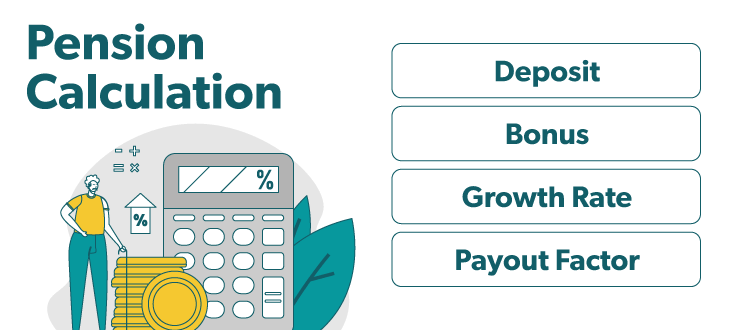
What we’re talking about here is creating a pension. This is the calculation. These are the factors that matter in this calculation. You make a deposit, $300,000. You receive a bonus, typically. You have a growth rate, and then you have a payout factor. We’ll go through these one by one, but these are how your lifetime income, your pension is calculated from the numbers that we just looked at.
You make the deposit of $300,000. The life insurance company is going to give you some type of arbitrary bonus. It might be 5%, it might be 20%, it might be 50%. It really doesn’t matter. The growth rate, they’re also going to provide you some type of growth rate to that pension account. Then, finally, they’re going to give you a payout factor. These payout factors are age-banded and determined by whether you choose to have a single lifetime income, guaranteed for as long as you’re alive, or a joint lifetime income, guaranteed as long as you’re alive and your spouse is alive. We make a deposit.
Which factors should you pay attention to?
The reason why I say bonuses are arbitrary and they really don’t matter is because all of this is essentially an actuarial formula, and they can tweak some of these different inputs to make one look better than the other, but then they can reduce its significance by changing, let’s say, the payout factor. Let’s say I gave you a 100% bonus, doubled your account value day one, then I promised it’s going to grow at 100% per year, the life insurance company. Then, that’s great, it’s going to grow to this huge amount, but what really matters in this instance is what’s the payout factor, because we’re going to take the payout factor and we’re going to multiply it by that 100% bonus growing at 100%.
If I say, you know what, the payout factor is 0.1%, well, however big that number is, if you only get 0.1% of it, when you multiply it, that’s your lifetime income amount, it didn’t really matter that you had a 100% bonus and a 100% growth rate because the life insurance company adjusted the payout factor down. These are carrots, right? At the end of the day, the income that it spits out is what matters in this situation, and the payout factor being so small has really mitigated all of those other carrots.
Now, I go through that just to point out that when we’re doing some comparison, it starts with the income, because I said earlier, there are about 15 to 20 companies that are pretty competitive in this fairly tight range. Then from there, we can look at some of the nuanced characteristics to determine if one is better than the other for your particular situation, but there’s really hundreds of companies out there, and probably even high hundreds, maybe even thousands of products, some of them have really, really low incomes.
Point being is I want you to understand when you look at these, when you see a high bonus or you see a high growth rate, the thing they’re typically not advertising is the payout factor. This is what you multiply by whatever this grows to, and that’s going to determine what your income is. Of course, you want to always know if you’re looking for a single lifetime or a joint income. Just so you’re aware, these payout factors, depending on if it’s single or joint and your age range, range typically between 5% to 8%.
In this particular example, $300,000, bonus of 20% turns the pension value into $360,000. Now it grows at 7%. That $360,000 is guaranteed to grow at 7% to calculate your lifetime income until you decide to activate the income. Let’s say you decide to activate it at 65, and you want a single lifetime income. It’ll be stipulated at 65 what the payout factor is for a single life and a joint lifetime income. Then you just multiply that by whatever this math formula has grown to, the $360,000 growing at 7%, and that is your lifetime income for a single person at age 65.
We’re about to jump into the planning, but I wanted to scroll back up to the top where we started, and show you now you have an understanding of how we got to these numbers. I said I did a little bit in reverse order here. It’s because I wanted to show you from a simplicity standpoint, this is really what matters. Let’s identify the range of income that’s available in the marketplace. Let’s see what the top 5 to 10 carriers are and products out there, and then start to look at some of the nuances.
Now that you know how the calculation is done, when we come back up here and I show you now for a one-year deferral at age 60, you make a deposit of $300,000, it’s guaranteeing you $17,000 to $20,000, maybe the top 10 carriers on the market in that range. You now know how we get to this number. You can also understand why when we’re deferring it longer, now the insurance company is guaranteeing you a much higher number because the age bands have increased because you’re older, and it’s been compounding at whatever rate these contracts are offering for a longer period of time.
Obviously, higher payout factor, more time to compound and defer, results in a higher level of income. Same concept when we get down here to 10 years of deferral, now at age 69, this is how we get to a higher range for that length of deferral.
Coordinating annuities with your other retirement income sources
Now onto our favorite part here at Oak Harvest Financial Group, because we’re retirement planning nerds, the planning part. The goal here is really two things. One, show you the flexibility and how the indexed annuity with an income rider can fit into a retirement plan. Then, two, show you how it works well with Social Security to provide even more flexibility, whatever life may throw your way over the next 10 years or so.
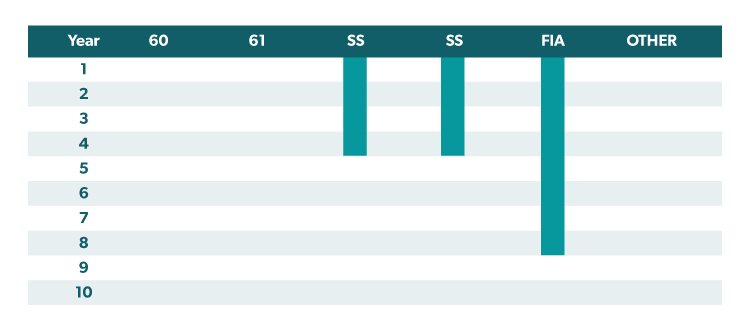
Pretty straightforward here. We have a 60-year-old spouse, 61-year-old spouse. We have length of time here for deferral. Let’s say they want to retire at age 65 here, or in 5 years. One strategy may be to plan on taking both spouses’ Social Security at age 65, to start income and allow the indexed annuity to defer 8 years, 9 years, 10 years, to get the maximum bang for the buck for the dollars input here.
I just put other over here because this could be various investments that you have. The thing with market-related investments, it’s not that you shouldn’t have market-related investments because these tools are designed, the indexed annuity, for people who want a portion secure from the stock market. It doesn’t mean they want all of it secure from the stock market. It’s while we can have a plan for what we expect this to do, we have no certainty of how much these other accounts will be worth in 3 years, 5 years, 7 years, 10 years. There’s an element of uncertainty. Whenever you introduce uncertainty into a planning process, you have a wider range of possible outcomes.
When you introduce more certainty into the planning process, you have a more narrow range of possible outcomes. That’s really what this is all about, is creating a bit more dependability, certainty, and narrowing the potential range of outcomes for you in your retirement. One iteration here, this is a tentative plan. We’ll take Social Security at 65, 65. We’ll get our biggest bang for the buck here. We’ll let this defer 8, 9, 10 years. We have a layering of income at different points in retirement. Then we can supplement whatever else we need from here.
Now, let’s say we decide, you know what, we’re going to look at this a little bit differently. Instead of the $300,000 going into one indexed annuity, we’re going to break it into two with the intention of different lengths of deferral for each. One spouse is going to take it at 67. The other one, let’s say this was the working spouse, the one with the highest Social Security, plans on deferring it until age 70. This could actually be an optimization for Social Security strategy.
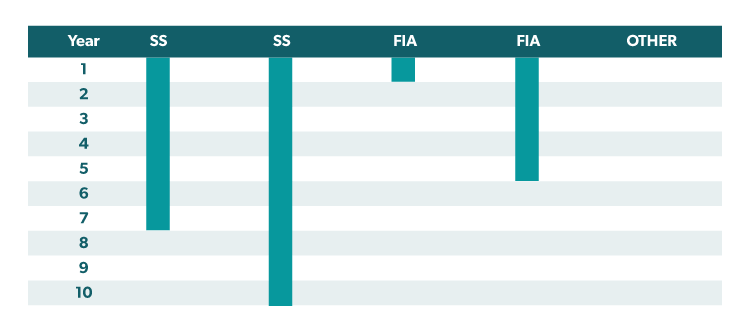
Let’s say the spouse maybe gets $1,200 a month or $1,500 a month, but this spouse has $3,800 a month at full retirement age, but wants to defer here. The spouse could turn hers on here. The husband defers until age 70. If this is $1,200 a month, as soon as he activates his, she is entitled to a raise that is equal to 50% of what his would have been at his full retirement age. Let’s say his at full retirement age was $3,800. She turns it on and gets $1,200 for hers, he now activates his at age 70. Let’s say he’s getting $4,500. At full retirement age, his would have been $3,800. Half of that is $1,900. She gets a raise from $1,200 to $1,900 a month. They’re both now age 70 down here. Now they have, I think $4,500 is what I said, plus $1,900, so that’s $6,400 per month from Social Security. We fill the gaps with some of the indexed annuities in years three and year five.
The benefit of flexibility in planning for life’s curve balls
I hope you’re starting to see how we have some different flexibility, not with when we activate the indexed annuity with income rider, but when we activate Social Security. You can imagine there are probably thousands of different iterations of what we can do, when we can do it, and what the final output is going to become. We have different timings with Social Security, different timings with indexed annuities, but life can change. Curveballs, things can get thrown at you. You’re planning on retiring here, maybe you don’t. You’re going to benefit from deferring this for a bit longer. Maybe you get laid off, and you are retiring sooner. Maybe you activate it sooner.
I just want to point out the built-in flexibility that exists when you start to add some of these elements to your retirement plan. Everything up to this point has talked about the pension account for the indexed annuity with income rider. It’s important to point out, though, that you also have a cash value account. You make that $300,000 deposit. We’ve been talking about the pension side. It actually has two different sides to the contract. Let’s say you put the $300,000 in and you got hit by a car the next day. That $300,000, that’s your death benefit, okay? Next year, or next 5 years, or 10 years.
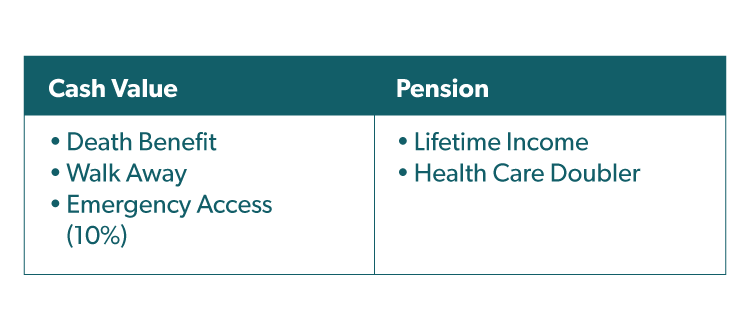
Your death benefit is always equal to the deposit that you put in, minus any withdrawals that you’ve taken out, plus any interest that’s been credited, and then minus any fees if there are any fees. Your cash value is the death benefit, it’s your walk-away money, and it’s also your emergency access. Now, I just did a video last week on how the cash value works for the indexed annuity. Here’s the link where you can connect to that video and understand in more depth how the cash value works.
What we’re talking about here, though, is when we add the income rider to it, and some of these companies will do it with no annual fees, and some companies will charge a 1% annual fee or so, but that income rate that we talked about, the payout factor, the compounding interest rate, I believe 7% was the example, all that is net of the fee. Whatever those terms are, whatever the guaranteed lifetime income is, all of that is net of any potential annual fee.
Some of the companies do offer a 1% fee for adding the pension account to the indexed annuity. Lifetime income, when we add the pension account, it now creates this guaranteed growth, a guaranteed payout factor, and guaranteed bonus to calculate our future lifetime income.
Some include a Home Health Care Doubler benefit
A lot of times we get a home healthcare doubler, so these are becoming more and more popular. Again, different terms and conditions for various contracts that are out there, but some of them are very, very, very powerful. What this means is if we go back here to the top, let’s say we’re using this for a long-term deferral, and we end up getting $44,000 a year.
Now let’s say at age 86 you have to go to a nursing home for 6 months and then you come home for home healthcare, that $44,000 could double to $88,000 per year for usually up to 5 years to help pay for those home healthcare costs, those long-term care facility costs. It’s a pension account that provides a pension, but that pension can also double to help you with long-term care expenses later in life. Not all indexed annuities with the income rider attached have that feature, and the ones that do, they have different terms and conditions, and you really want to understand how they work. That’s where, again, working with someone who’s familiar with this marketplace can help explain that to you.
We’re talking about– This whole video has been about this side, the pension account. I just want you to be aware that you do have a death benefit, you do have a walkaway value, and you do have emergency access, typically 10% per year. It’s important to point out, though, if you’re dedicating money to this type of strategy for your retirement, it is a long-term retirement income strategy. This is not a short-term strategy. This is designed to make a deposit, let it grow, compound, provide you a lifetime income. You’re planning on having this for as long as you’re alive.
Surrender charge schedules in case you need to take your money back early
If something does happen, you change your mind, you pass away, or you plan on deferring it for 10 years, but now you need $20,000, well, you do have emergency access here. Important to point out because a lot of people think that when you do this strategy for your retirement that you no longer have access to your principal, your lump sum, and that’s incorrect. All indexed annuities with income riders come with a surrender charge schedule. This helps the insurance company know what their assets are, what their liabilities are, and for you, it’s a downside in the sense that if you change your mind, if you decide to walk away, you can have up to 10% annually free withdrawal privileges.
If you break the terms, you have a surrender charge period here, and if you put it all in and then the very next day or next year or in two years, you say, “You know what, I changed my mind. I want to take all my money back and go buy this Lamborghini,” the insurance company, they’re going to charge you a pretty hefty fee for breaking the surrender charge schedule. Typically, these are going to go over a 10-year period, and the fees are pretty hefty in the beginning.
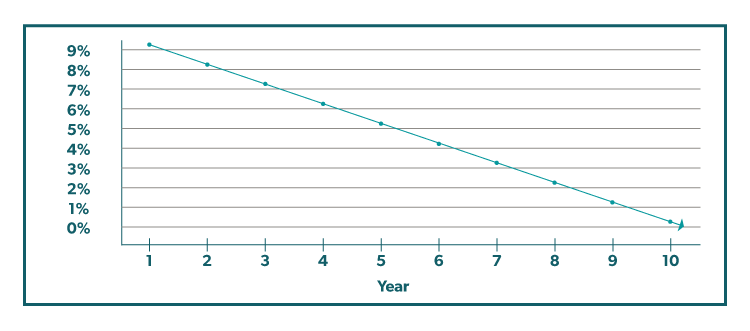
This is something you want to have some certainty about that is good for you in your retirement, because the fees typically start at 9%, then they go down on average about 1% per year. 9%, 8%, 7%, 6%, 5%, 4%, 3%, 2%, 1%, 0%. After the 10th year, you typically have 0% surrender charges. If you change your mind and you’re 11, 12, or 15, sure, you can take all your cash value minus any withdrawals, plus any interest, minus any fees, the net balance of your account value, you can take it and go buy that Lamborghini. If you surrender it during this first 10 years, they are going to hit you with a penalty. Understand this is not a short-term strategy. This is a long-term retirement income strategy.
Now, if you should pass away during the surrender charge schedule, this is not imposed. It’s not a penalty for dying. It’s only part of the walkaway value during the first 10 years. One more important point of clarification here before we get into the tax planning side, and that’s just going to be for a couple of minutes. We’ve talked about nothing but the pension side in 99% of this video. The bonuses, the guaranteed rates, the 7% in our example, that’s all used to calculate the pension value.
If you decide to break the contract and you walk away, you do not get to keep that bonus. You do not get to keep that interest that was used to calculate your lifetime income. All of that is part of the formula that’s used to determine how much annual income you’re going to receive in mailbox money per year for the rest of your life and your spouse’s life. Last part. If you watch my channel a lot, you know we’re big proponents of the Roth conversion. We’ve probably done over $100 million of Roth conversions for clients over the past four or five years.
Tax planning considerations: You can still do Roth Conversions
Big proponents because we understand the big picture of how having tax-free money in your retirement plan has a trickle-down effect, potentially to your Social Security, your Medicare, your investment income, so many different aspects, and not to mention the legacy, passing money on to kids and grandkids. With the indexed annuity, when you attach an income rider, you can still do Roth conversions. Now, when you do Roth conversions, and this is your primary source of income, let’s say in retirement, the income annuity and the Social Security, you have the potential to even turn your Social Security into a tax-free stream of income as well.
Let’s say you have some assets over here not generating a ton of interest or income. They’re designed for growth. You don’t need them. We’re getting income from the income rider. We’re getting income from Social Security. We could have $50,000, $100,000 of annuity income, as long as it’s been converted to Roth, and $100,000 of Social Security income, and we would not pay a single dollar in tax on our Social Security income. When we start to now integrate tax planning, along with the income planning, we can start to really see some potentially huge benefits, not just on the income side, but on the tax side as it pertains to Social Security.
Having a carefully curated plan that looks at these strategies for stable income, baseline income planning, and then converting to Roth to turn that into tax-free streams of secure and dependable income for your retirement has trickle-down effects, possibly to your Social Security, and even your Social Security could be tax-free. Again, I like these because they’re planning tools. They create some certainty and dependability for your retirement, and layering the tax planning on can make it all the much that better.
Comment down below. Let me know what you think. Really powerful stuff we covered in this for those of you who, just like me, just like a lot of our clients, want some portion of your retirement to be protected from the stock market and being there for you to generate dependable streams of lifetime income.
Do you need a Retirement Success Plan that goes beyond allocating funds to truly fit your needs? We can help you create a retirement life plan customized for your retirement vision and legacy. Call us at (877) 404-0177 or fill out this form for a free visit: https://click2retire.com/retirement-income-payouts