

Weekend Update, December 15th, 2025
Index, Sector, and Asset Performance
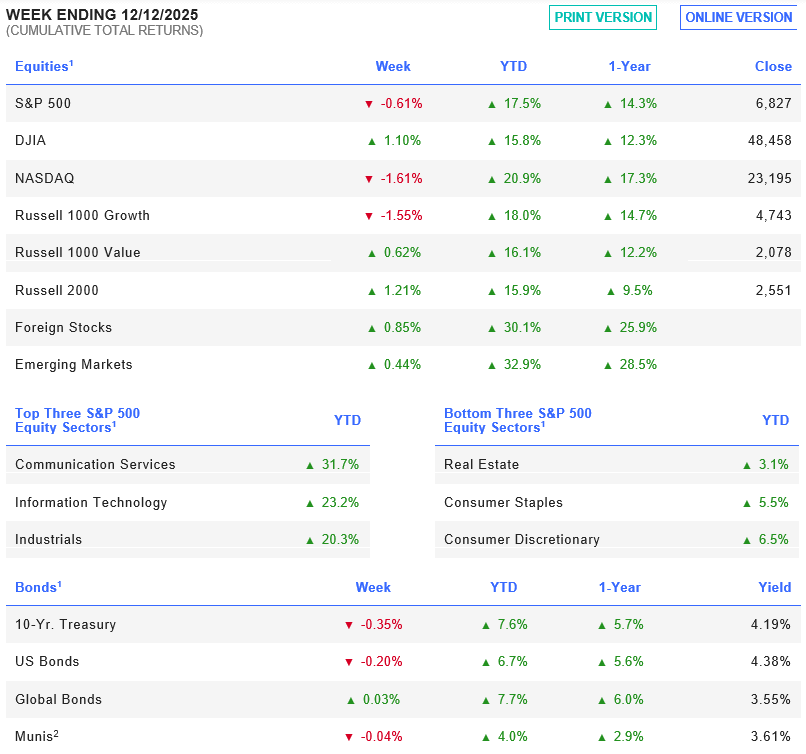
Equity markets continued last week as they have in December, mixed. The S&P 500 fell -0.6% as gains in cyclical financials, industrials, and materials were offset by weakness in YTD leaders’ technology and communication services. The S&P 500 ended last week at 6,827. The S&P 500 is down -0.3% MTD December but up +16% for YTD 2025. Communication services led the S&P 500’s sector losses falling -3.2%, followed by a -2.3% drop in technology and a -1.1% loss in utilities, as long term nominal interest rates rose. Real estate and energy also fell. On the upside, materials climbed +2.4%, followed by a +2.3% gain in financials, and a +1.4% advance in industrials. Consumer staples, health care and consumer discretionary also rallied a bit.
Per Bespoke Research, the S&P 500’s median December performance since 1945 has been a gain of +1.5% with positive returns 75% of time. In the 9 years when the S&P 500 was up over 10%+ YTD, but November was down, like this year, the median December gain was +3.9% with gains every time. However, historically, almost all of those positive gains came after the 15th trading day in December which is this Friday the 19th.
The AI trade peaked in mid-October and continued to pullback last week with a number of names (AVGO, ORCL, Lasers) selling off sharply late in the week. Cyclicals have rallied sharply in recent weeks, outperforming Defensives and Core Growth for a record 14 consecutive days. This reversion to the mean trade is seen quite often in November and early December as large pension funds and institutional allocators reposition asset style and factor weights in their portfolios.
Asian stocks started this week with broad losses. The YTD leader South Korean index led the losses with a decline of -1.8%. Both the Japan Nikkei and Hang Seng finished down -1.3%. China finished lower on the back of weak economic data and Xi caution, with the losses at -0.6%.
Most sell-side Wall Street firms have released their 2026 outlooks and S&P 500 price objectives with the groups decidedly more positive than the last few years. Wall Street’s consensus price targets for S&P 500 companies expected 12-month return is +16.7 pct, equating to almost 7900-8000. History says this is likely aggressive given second year Presidential terms.
The Federal Reserve cut rates by 25 bps, to 3.625%. The statement was dovish versus expectations with Powell arguing that rates are now in the neutral range, albeit at the higher end. Core inflation is dropping but still stuck around 3%. The market is still pricing in another 50 bps of easing in 2026.
Per Goldman Sachs 1-Week asset returns:
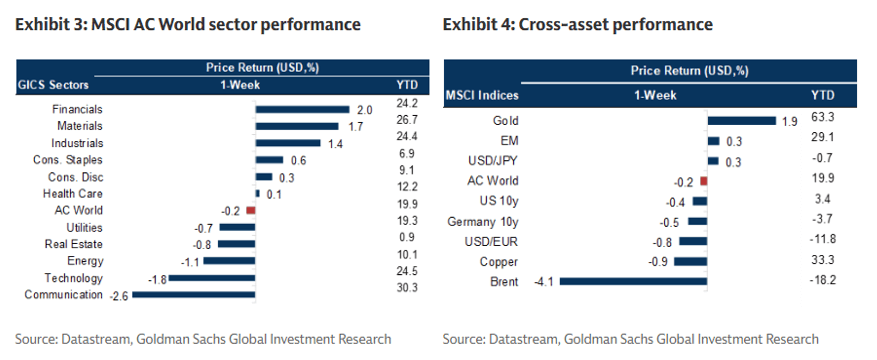
US 10-year Treasury yields rose and sits near 4.15%. The 2yr US Treasury note yields 3.5%, about 25 bps below the lower end of the current fed funds band (3.75%=4.00%).
Economic Indicators and Earnings Commentary
The delayed November employment report is set to be released on Tuesday, December 16 at 8:30am ET. The report will also include establishment survey data for October, which was collected after the end of the federal government shutdown.
Reported earnings have come in well ahead of consensus expectations in Q2 and Q3 of 2025.
For 2026, S&P 500 earnings and earnings growth looks to triangulate around $300-305/shr and 12% YTY growth for the year. Peak YTY growth looks to be in 4q26 nearing 17% YTY. Per Goldman Sachs, the 7 largest stocks in the S&P 500 (NVDA, AAPL, MSFT, GOOGL, AMZN, AVGO, META) account for about 36% of S&P 500 market cap, 26% of current earnings (TSLA drags the number down) and should contribute over 45% of EPS growth in 2026.
Easing 2025 tariff pressures, accelerating productivity growth, and labor market slack can support operating profit margin expansion in 2026.
A waterfall of FOMC speakers hit the circuit this week.
Oracle’s adjusted earnings per share beats expectations but its revenue missed the Street view. The revenue miss came as slower cloud revenue and heavy AI data-center spending raises questions about debt-funded expansion. Oracle had the largest loss in the technology sector, falling -13%.
Broadcom posted higher-than-expected adjusted earnings per share for its fiscal Q4 but issued a warning that gross margins will decline sequentially amid a bigger mix of AI-related revenue. Broadcom was also among the worst performers, dumping -7.8%.
The earnings calendar this week is light but includes Pfizer, Lennar, Micron Tech. General Mills, Jabil, Nike, FedEx, Darden Restaurants, and Carnival Cruise lines.
Commodities and Currencies
Oil and its products fell below $58/bbl. Copper, gold, silver and other industrial metals have hit new ATHs. Precious metals like gold and silver continued their strong YTD performance with gold back over $4,350/oz. Crypto assets and bitcoin have been volatile since pulling back from their mid-summer $125k ATH.
The US dollar still sits near 99.
OHFG Stock Talk
2026 Market Outlook 1H Preview: Some Years, You Draw a Harder Bull Ride
Past performance is no guarantee of future results. Indexes are unmanaged and one cannot invest directly in an index. They do not reflect any fees, expenses or sales charges. The preceding discussion is for informational purposes only. Investing involves risk and no reference to any security listed above should be considered a buy or sell recommendation. Advisory services are provided through Oak Harvest Investment Services, LLC, a registered investment adviser.