

Average Retirement Savings for Married Couples by Age: Are You Hitting the Mark?

By
Cindy Schrauben
Reviewed by Nathan Kattner
Many couples nearing retirement wonder if they’ve saved enough. Looking at the average retirement savings for married couples by age can provide perspective, but what truly matters is turning your savings into a plan that supports your life.
Key Takeaways
- The median retirement savings for married couples ages 55–64 is approximately $185,000.
- Couples ages 65–74 have a median retirement savings of roughly $200,000.
- National averages are useful benchmarks but shouldn’t determine your retirement plan.
- Retirement income planning is often more important than total account balances.
- Social Security, pensions, taxes, and healthcare costs significantly impact retirement readiness.
- Catch-up retirement contributions after age 50 can substantially increase savings.
- Distribution planning becomes just as important as investment growth near retirement.
- A personalized retirement income strategy can provide more confidence than comparing yourself to national averages.
Why Does Your Retirement Plan Matter More Than Average Savings?
If you’re like many couples approaching retirement, you’ve probably wondered, “Are we saving enough?” It’s a common and deeply personal question, and the answer often starts with a number. Comparing your progress to the average retirement savings for married couples by age can offer helpful context, but it doesn’t tell the whole story.
What truly matters is how your savings translate into income, security, and confidence for the years ahead. And if you feel behind, there’s good news: There’s still time to catch up and plan wisely.
Whether you’re ahead of the average or still catching up, the key is having a plan built around your life, not someone else’s numbers.
What Retirement Savings Averages Really Mean for Married Couples
Seeing the average retirement savings for married couples by age gives you perspective, but it doesn’t define your outcome. Averages – whether mean or median – help spark the conversation, but real progress comes from creating a strategy that reflects your actual needs.
Every couple faces a different starting point, income level, and risk tolerance. That’s why Oak Harvest’s Retirement Success Plan customizes how your income will be structured, coordinates the best time to claim Social Security, and builds in tax strategies that fit your situation, not just national statistics.
Before diving into the numbers, it helps to understand the difference between median and mean.
- The median is the midpoint. Half of households have more, half have less. This number often provides a more realistic view.
- The mean is the mathematical average. It can be pulled higher by households with substantial savings.
Both are useful, but the median usually reflects the experience of typical families more closely.
How average retirement savings for married couples by age stack up in your 50s, 60s, and 70s
Let’s break down the averages by age and talk about what they really mean for couples at different stages of life.
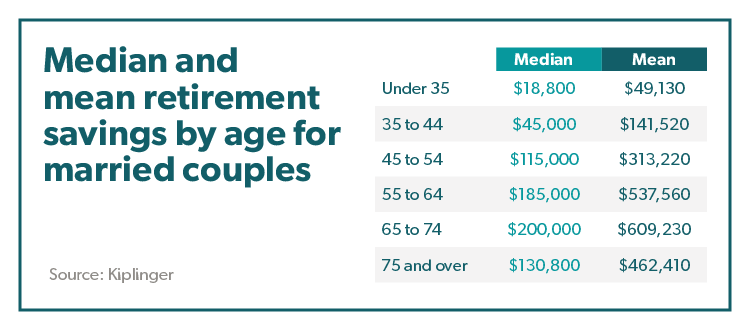
(Source: Kiplinger)
Married couples in their 50s
The average retirement savings for married couples by age in the 55 to 64 range is about $185,000 in median terms and $537,560 on average. This decade often marks peak earnings and the highest expenses, like paying for children’s college tuition and supporting aging parents financially.
Couples in their 50s can make meaningful progress by using catch-up contributions, considering whether Roth accounts make sense, and adjusting portfolios so they reflect income needs and comfort with risk.
Beyond contributions, this stage is often the first time couples can see what their retirement income picture might actually look like. Many start running projections of how much monthly income their savings could provide and whether that income would cover their lifestyle.
Your 50s are also when questions arise, such as, “What is a good monthly retirement income for a couple?” And “How long will my money last in retirement?” Exploring these questions early provides valuable time to make course corrections.
It’s also a decade when tax planning can have a long-lasting impact. Strategic moves like shifting money gradually into Roth accounts, rebalancing investments to prepare for future withdrawals, or evaluating when to claim Social Security can help reduce tax burdens in retirement.
The earlier you begin coordinating these decisions, the more flexibility you will have to adapt as retirement approaches. Discover more about preparing for retirement in your 50s by watching the video “6 Things to Avoid When You’re 5-10 Years From Retiring” by Oak Harvest’s Founder and CEO Troy Sharpe.
How Much Retirement Savings Should Married Couples Have in Their 60s?
Couples aged 65 to 74 report a median of $200,000 and an average of about $609,230. This is when many begin living off their savings and Social Security.
At this stage, it helps to coordinate how and when to draw from different accounts, decide the right time to claim Social Security, and ensure investments are aligned with a reliable income stream.
For many, the 60s are also when retirement becomes real rather than theoretical. Some couples retire in their early 60s, while others wait until their late 60s or beyond.
The decision of when to stop working isn’t just about finances. The retirement decision often involves lifestyle goals, health considerations, and even how ready each spouse feels emotionally for such a significant transition. Having open conversations together helps align expectations and ensures both partners feel secure.
Healthcare planning also becomes a top priority in this decade. Medicare eligibility begins at age 65, but out-of-pocket costs can still be significant.
You must account for supplemental insurance, prescription coverage, and potential long-term care expenses. Building these expenses into a retirement plan helps prevent unpleasant surprises and allows savings to stretch further.
Understanding the true scope of healthcare expenses is crucial for retirement planning.
According to recent estimates, a healthy 65-year-old couple with traditional Medicare paired with Medigap Plan G and Part D coverage may need approximately $388,000 to cover healthcare costs throughout retirement, not including long-term care. The costs are lower at about $183,000 if a couple chooses Medicare Advantage plus Part D.
Remember, all estimates can vary significantly based on health status, location, and coverage choices.
Beyond Medicare premiums, you should budget for supplemental insurance (Medigap policies), prescription drug coverage, and dental and vision care that Medicare doesn’t fully cover.
Long-term care represents another significant consideration, with average annual costs ranging from $50,000 for home care to over $100,000 for nursing home care in many areas.
Many couples find that Health Savings Accounts (HSAs) become invaluable in retirement, as funds can be withdrawn tax-free for qualified medical expenses. If you’re still working and have access to an HSA, maximizing contributions in your final working years can create a dedicated healthcare fund for retirement.
Healthcare planning is where the Retirement Success Plan becomes critical. Your plan will help you to coordinate how and when to draw from different accounts, decide the right time to claim Social Security, and ensure investments are aligned with a reliable income stream.
What Is the Average Retirement Savings for Married Couples in Their 70s?
By the 70s, savings levels often decline as couples begin drawing down assets. Median balances fall to about $130,000, while averages remain near $462,410.
Here, the focus shifts to managing required minimum distributions, planning for healthcare, and simplifying finances for clarity and security.
Many couples also use their 70s to think about legacy planning. Questions like “How do we pass wealth to children or grandchildren in a tax-efficient way?” often come to the forefront. Decisions about gifting, trusts, or charitable giving can make a meaningful difference in how wealth is preserved and transferred to the next generation.
Day-to-day financial management also takes on new importance. Simplifying accounts, automating withdrawals, and consolidating investments can help reduce stress and limit mistakes.
For couples, making sure both spouses are familiar with household finances is critical. This ensures that if one partner becomes unable to manage money due to health issues, the other can step in with confidence.
Coordinating retirement as a team
Retirement planning for couples requires careful coordination, especially when spouses are at different career stages or have age gaps. The spouse who retires first may need to bridge health insurance through COBRA or marketplace plans until the working spouse’s employer coverage is available, or until Medicare eligibility begins.
Social Security claiming strategies become particularly important for married couples. The higher-earning spouse might delay claiming until age 70 to maximize benefits, while the lower-earning spouse claims earlier. This strategy can significantly increase lifetime benefits, especially considering survivor benefits. When one spouse passes away, the surviving spouse receives the higher of the two Social Security payments.
For couples with significant age differences, coordination becomes even more critical. The younger spouse may need to work longer to bridge the gap until they’re eligible for Social Security and Medicare. In comparison, the older spouse might need to structure withdrawals to last until the younger spouse has additional income sources.
Communication is essential throughout this process. Both spouses should understand the household’s complete financial picture, including account locations, passwords, and the reasoning behind key decisions. Regular “financial meetings” can help ensure both partners feel informed and comfortable with the retirement strategy as it unfolds.

Click to see all the latest retirement videos for your Retirement Income Planning research.
What to do next if your savings are below average
If your numbers fall short of the average retirement savings for married couples by age, do not panic. What matters most is how you respond from here. It’s still possible to make significant progress even in your 50s and early 60s.
Prioritize income planning over total savings
Instead of focusing only on account balances, you should look at building reliable income streams. This includes dividend-paying portfolios, annuities, Social Security, and more.
The question is not just how much you have saved, but how long your money will last in retirement. Oak Harvest founder and CEO shares his strategies for this stage of life in this video.
Maximize catch-up contributions and consider tax-smart strategies
Once you reach age 50, retirement accounts allow higher annual contributions that can meaningfully boost savings in the years leading up to retirement.
In 2025, the catch-up limit for 401(k) plans is $7,500.
Looking ahead to 2026, the base contribution limit for employees under 50 is expected to rise to $24,500, while those age 50 and older may contribute an additional $8,000 in catch-up contributions. If you’re over 50, your total potential annual contribution will be $32,500. (2026 numbers are estimates; please check IRS.gov for official announcements.)
These higher limits can create valuable opportunities for couples in their 50s and early 60s to accelerate their savings. Maximizing contributions during this stage not only builds balances but may also reduce taxable income for the year.
Beyond contributions, strategies such as Roth conversions or funding a health savings account (HSA) can further strengthen retirement readiness by improving tax efficiency and creating future sources of tax-free withdrawals.
Shift from accumulation to distribution thinking
If your investment strategy still looks like it did in your 40s, it might be time to adjust. Distribution planning helps protect your principal, manage volatility, and create a reliable paycheck from your portfolio.
In the accumulation years, the focus is on growth by maximizing returns and building balances for the future. But once retirement approaches, the priorities shift. Instead of chasing the highest returns, the goal becomes turning savings into a sustainable stream of income that lasts for decades. This requires balancing growth investments with more conservative holdings that can weather market downturns without forcing you to sell at a loss.
Distribution planning also means coordinating which accounts to draw from and when. For example, pulling too heavily from tax-deferred accounts early on could trigger unnecessary taxes, while waiting too long to tap those accounts may lead to larger required minimum distributions later. A thoughtful approach can extend the life of your savings and reduce surprises down the road.
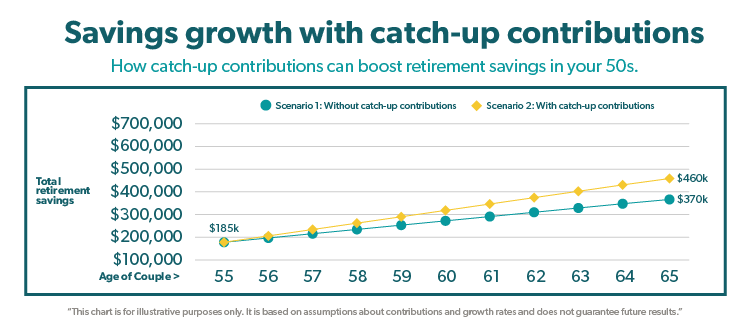
This chart illustrates how adding catch-up contributions in your 50s can close the gap between being below average and nearing retirement with more confidence.
What to consider if you want $100,000 a year in retirement income
You might be aiming for a six-figure lifestyle in retirement. If so, you may be asking, “How much money do I need to retire with $100,000 a year in income?”
Here is a simple way to look at it:
- Using the 4% withdrawal rule, you would need about $2.5 million in savings.
- If you expect $30,000 a year from Social Security, your savings goal drops to about $1.75 million (go to ssa.gov/myaccount to find your estimated Social Security income).
These numbers are only starting points. Your personal target depends on taxes, health care, inflation, and legacy goals.
Inflation deserves special attention in retirement planning because it compounds over time. Even modest inflation of 3% annually means that $100,000 in today’s purchasing power will require $134,000 in income after just 10 years of retirement. Over a 25-year retirement, that same lifestyle would cost approximately $209,000 annually.
This is why many retirement portfolios need some growth component even during the distribution phase. While conservative investments offer stability, keeping a portion of your portfolio in assets that can grow with or ahead of inflation – such as stocks, real estate investment trusts (REITs), or Treasury Inflation-Protected Securities (TIPS) – helps maintain purchasing power over the long term.
When calculating your retirement income needs, consider building in annual increases of 2-4% to account for inflation. This approach helps ensure your lifestyle doesn’t gradually erode as costs rise over time.
The difference Social Security makes
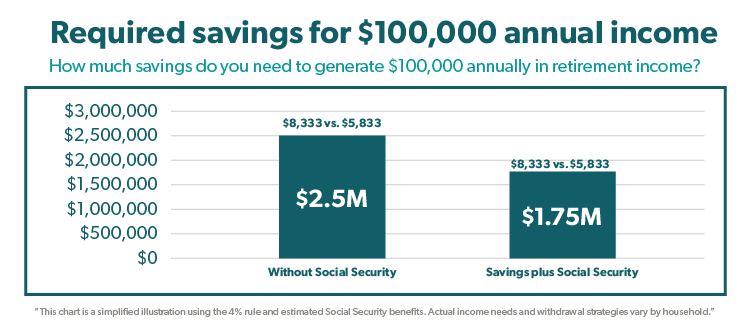
This example highlights just how much of a difference Social Security can make in retirement planning. Without it, a couple aiming for a $100,000 a year income would need roughly $2.5 million in savings, assuming a 4% withdrawal rate. But when you factor in $30,000 of combined Social Security benefits, the required savings drops to about $1.75 million.
The main point is that your savings goal isn’t one-size-fits-all. The combination of Social Security, pensions, annuities, and investment income will influence how much you actually need. By considering all sources of income together, you might realize that the amount needed to support your lifestyle is more achievable than it first appears.
Why personalized retirement planning creates better outcomes
It is tempting to measure your progress against national benchmarks like the average retirement savings for married couples by age, but planning for retirement is not about averages. It is about what matters most to you and your spouse.
DIY approaches often overlook crucial details, such as timing withdrawals, minimizing taxes, or strategically allocating investments for income. At Oak Harvest, we personalize every plan around your lifestyle, not generic formulas. Oak Harvest Financial Group’s advisors would be happy to help guide you during your planning process.
Confidence in retirement comes from planning, not averages
Whether you are above, below, or right in line with the average retirement savings for married couples by age, what matters most is having a clear, confident plan to move forward.
With the right guidance and a few adjustments, you can build lasting income and peace of mind for the years ahead.
Ready to create your retirement plan?
Schedule a call with Oak Harvest today. We’ll help you build a retirement plan that works for your life, not someone else’s numbers. Schedule a call today!
Frequently Asked Questions About Retirement Savings for Married Couples
How much retirement savings should a married couple have at age 60?
Many financial studies show wide variations in retirement savings levels. The amount needed depends on lifestyle, healthcare costs, expected retirement age, Social Security benefits, taxes, and income needs.
Is $500,000 enough for retirement for a married couple?
For some couples, $500,000 may support retirement when combined with Social Security or pensions. For others, it may not be sufficient. Retirement readiness depends on spending needs, healthcare costs, inflation, taxes, and withdrawal strategy.
What is considered a good monthly retirement income for a couple?
Retirement income needs vary widely. Some couples may need $5,000 per month, while others may require significantly more depending on housing, travel, healthcare, taxes, and lifestyle expectations.
How much money do you need to retire with $100,000 a year income?
Using a 4% withdrawal guideline, generating $100,000 annually from investments alone may require approximately $2.5 million in retirement savings. However, Social Security income and other income sources may reduce the required savings amount.
Why do average retirement savings vary so much?
Average savings figures can be skewed higher by wealthier households. Median savings often provide a more realistic picture of what typical families have saved.
Oak Harvest related content:
Retirement: I’m 65 with $1.3M Saved. Should I Do a Roth Conversion?
Estate Planning Checklist: Essential Steps to Protect Your Legacy
Will My Social Security Payment Increase if I Keep Working After I Start Receiving Benefits?
Let Us Help You Achieve the Retirement You Deserve!
Investment Advisory services are provided through Oak Harvest Investment Services, LLC a Registered Investment Advisor. Insurance services are provided through Oak Harvest Insurance Services, LLC. Oak Harvest Investment Services, LLC and Oak Harvest Insurance Services, LLC are not affiliated with the U.S. government or any government agency. Information presented is for educational purposes only intended for a broad audience. Not an offer or solicitation for the sale or purchase of any specific securities, investments, or investment strategies.
“Peace of Mind,” “Safety,” “Principal Protection,” “Lifetime Income, “Guaranteed Income,” or other guarantees are associated with fixed insurance products. No such language refers in any way to investment advice, investment advisory products, securities, or recommendations provided by Oak Harvest Investment Services. Investing involves risk. Rates of return are not guaranteed unless otherwise stated. All guarantees are dependent on the financial strength and claims-paying ability of the issuing insurance company. Annuities have limitations and are not appropriate for all circumstances or individuals. They are not intended to replace emergency funds or to fund short-term savings or income goals. Lifetime income may be available on certain products through an optional rider, at no cost or for an additional cost, depending on the contract. Insurance products are not insured by any federal government agency and may lose value. By contacting us, you may be offered information regarding the purchase of insurance and investment products.
Oak Harvest has a reasonable belief that this marketing does not include any false or material misleading statements or omissions of facts regarding services, investment, or client experience. Oak Harvest has a reasonable belief that the content as a whole will not cause an untrue or misleading implication regarding the adviser’s services, investments, or client experiences. Please refer to www.oakharvestfg.com for additional important disclosures.