

What is a Fixed Indexed Annuity? A Comprehensive Guide to Features, Risks, and Retirement Strategies
A video and vlog by Oak Harvest Insurance Services, LLC


Key Takeaways:
-
Protection: 100% protection against stock market losses.
-
Growth: Gains are linked to an external index (like the S&P 500) but capped at a certain limit.
-
Liquidity: Most offer a 10% annual penalty-free withdrawal.
-
Best For: Retirees looking for an alternative to bonds who prioritize “Sequence of Returns” protection.
A long time ago, I had a client come in and say, “Troy, I don’t know why anyone would ever buy an annuity. The insurance company keeps your money when you die, they’re super high in annual fees, and they don’t earn any interest. They never grow. I don’t understand it.” That’s when I realized how misunderstood annuities actually are. In today’s video, we’re going to discuss one specific annuity, the fixed indexed annuity, and discuss its features, its limitations, and also its functional use inside of a retirement plan.
A lot of the confusion seems to stem from people not being clear when they’re discussing annuities and various features and limitations as to which type of annuity they’re actually discussing. The client’s story from the beginning, when he said annuities are high in fees, well, variable annuities typically are high in annual fees, but with fixed annuities, there are no annual fees. The insurance company keeps your death benefit when you pass away. Immediate annuities, whenever you select a single life option, meaning you’re choosing an income for life, and when you die, the money’s gone, it’s something that you choose, that is a feature of the immediate annuity.
Why do annuities have such a bad reputation?
The reputation of annuities often suffer because various products, each with distinct pros and cons, are incorrectly lumped into a single category. Over time, a narrative has been created that all annuities share the same negative features. While that may be true for some, it is typically untrue for the many different types available today. We’re going to clear that up by looking specifically at Fixed Indexed Annuities; their features, their limitations, and most importantly, their functional use inside of a retirement plan.
What is a Fixed Indexed Annuity and how does it work?
Let’s start with the term ‘Fixed Indexed Annuity.’ Fixed means your principal is 100% protected from market losses; it is fixed, meaning it cannot go down even if the stock market loses value. Indexed means your potential gains are linked to an external index, such as the S&P 500. Your money isn’t actually invested in the stock market; instead, the market’s performance determines how much interest you earn. If the market goes down, you don’t lose a penny of your principal or your previously earned interest.
How do Fixed Indexed Annuities compare to Fixed or Variable Annuities?
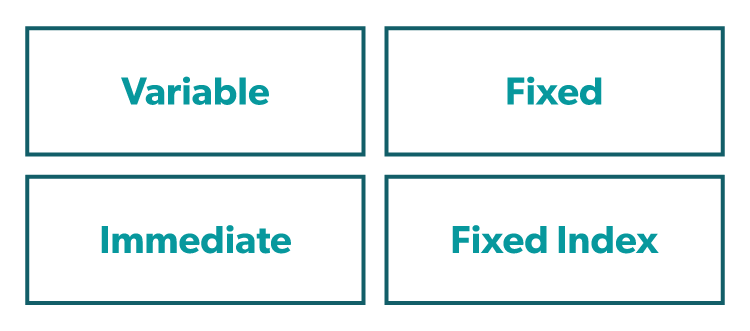
Unlike variable annuities, which carry market risk, and fixed annuities, which pay a set interest rate, fixed indexed annuities offer protection from losses while linking potential gains to a market index. The term “annuity” ultimately refers to a contract with an insurance company that provides the option to convert a lump sum into guaranteed lifetime income. This feature allows for the creation of a personal pension to address longevity concerns, whether through deferred growth or an immediate annuity for instant cash flow.
Let’s look at the variable annuity. Variable just simply means that your money is variable. It can go up, it can go down. It is directly placed into the stock market. It has market risk. Fixed, it’s 100% secure from market losses, but instead of your interest gains being tied to an external index like the S&P 500, fixed annuities just simply pay you an interest rate, like 3% for three years, 5% for five years.
The word annuity on the end of all of these just simply means that it is a contract issued from a life insurance company that has the choice to turn that lump sum into a pension or into a guaranteed lifetime income. You do not have to exercise that feature, but it is there if you choose to activate it.
A lot of times, you may want to do that a little bit later in life. If you’re running out of money or you’re concerned about longevity, you could turn your contract into a stream of guaranteed lifetime income. That’s what the word annuity actually means. An Immediate annuity just simply means you make a deposit with the life insurance company, and then it immediately starts providing you income, typically in 30 days.
What are the key features and benefits of a Fixed Indexed Annuity (FIA)?
Fixed indexed annuities are designed to provide secure, protected growth by locking in gains through an annual reset and ensuring your principal is never exposed to market risk. Earnings are tied to an external index like the S&P 500, with growth typically managed through participation rates and caps to target a steady average return. Ultimately, these contracts can help offer more certainty in a retirement plan, including a death benefit that ensures the full account value is passed on to beneficiaries.
The details
Fixed indexed annuities are designed to provide protected growth in income, protected from stock market losses. Secure growth and secure income. They help create some certainty in a retirement plan.
They have something known as an annual reset. An annual reset is a key feature of a fixed indexed annuity that “locks in” your gains every year so they can’t be lost to future market volatility. Typically, it’s a 12-month contract year. If your contract is issued today, 12 months from now, you have an annual reset, and your values get locked in. Unlike a standard fixed annuity that offers a guaranteed interest rate, such as 4.5% per year for five years, a fixed indexed annuity ties your earnings to the performance of an external index like the S&P 500.
There are crediting methods, which we’ll discuss again in just a moment. They have no market risk. Again, these are attractive to the person in retirement that is more concerned about protecting their principal than taking aggressive risks. They are designed to average around 4-7% per year. The death benefit equals the full account value, or what’s known as the full accumulation value. All principal plus interest earned, minus any withdrawals is your death benefit.

How Do Participation Rates, Caps, and Annual Resets Work in an FIA?
Growth in a Fixed Indexed Annuity is calculated using a participation rate, which is the percentage of index growth credited to the account, and a cap, which is the maximum interest rate the contract can earn during a set period. These are paired with the annual reset feature that locks in gains every 12 months, effectively creating a new “floor” for the principal and ensuring that the account value never decreases due to market volatility.
I like to tell my clients to think of this as a “one-way ratchet.” Your money can click upward when the market performs, but the mechanism prevents it from ever sliding backward. To understand the math behind your statement, you have to look at how these three levers, participation, caps, and resets, work together.
While there are many types of FIAs, the basics usually come down to two factors. The participation rate determines how much of the index’s growth you actually “participate” in. Often, you’ll see 100% participation paired with a cap (a limit on your gains). For example, if your cap is 10% and the S&P 500 goes up 20%, your earnings are limited to 10%.
The magic happens at the end of the year when that 10% is locked in. Your $100,000 becomes $110,000, and it will never be worth less than that again.
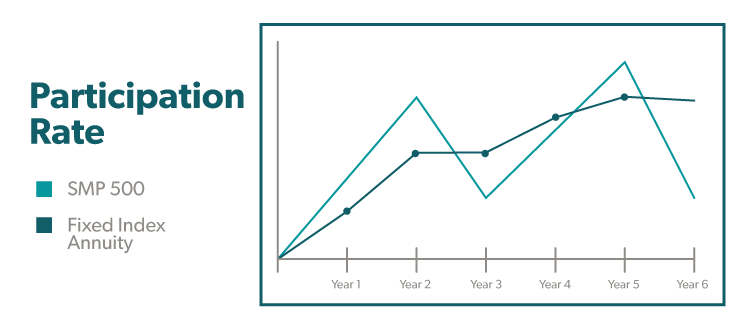
Here’s a visual illustration of what that might look like. The black line represents the S&P 500 and the blue line represents your fixed indexed annuity with 100% participation and let’s say a 10% cap. These represent your contract years. You make your deposit, year one, year two, year three, year four, year five, year six, et cetera. The market goes up in the first year, you don’t make all of the market gain. You make it up to either a cap or, if you have an uncapped strategy, then up to the participation rate.
Here we’ll say the market goes up, let’s say 25, but we have a 10% cap. We make up to 10%. That gain is locked in, so now that’s your new value. Market goes up year two, between years one and two. Market goes up, your contract goes up to the cap. If the market goes up, let’s say 15 here, you make up to the cap of 10. Now, the market goes down in year three, between years two and three, but you go sideways. You don’t lose any money. These are what are called the annual resets.
Now, one of the benefits of the annual reset is you start to track the stock market from wherever it is on your contract anniversary. It’s like a new horse race every 12 months. Wherever the stock market is on your contract anniversary, that’s your starting point. Even though your values are still up here, because you didn’t lose when the market went down, you start tracking the market between years three and four from this point to wherever it is at the end of year four. If the stock market goes from here to here, your contract goes from here to here.
Between years four and five, the market goes up, so does your contract. Then here we show the market going down. You don’t lose any principal. You don’t earn any interest, because each year on your contract anniversary, you have that reset feature, and your values are locked in.
What are the downsides and limitations of Fixed Indexed Annuities?
The primary limitations of Fixed Indexed Annuities (FIAs) include limited liquidity, surrender charge schedules, and IRS early withdrawal penalties. Most FIA contracts restrict penalty-free withdrawals to 10% of the account value annually and are designed as long-term retirement vehicles; liquidating the full contract before the surrender period ends (typically 5 to 10 years) can result in significant exit fees.
It’s important to be candid: FIAs are not a “get rich quick” or “emergency fund” tool. They are specific instruments for a specific job, and if you try to use them for short-term needs, the costs can be hefty.
First and foremost, these are not short-term tools, they are designed for retirement. Much like an IRA or 401(k), if you make a withdrawal prior to age 59 ½, you may be subject to a 10% IRS early withdrawal penalty. This is why we typically don’t recommend them for younger investors or for money you might need in the next year or two.
Once you are in retirement, you do have some flexibility through a 10% liquidity provision. For example, on a $100,000 account, you can typically take out up to $10,000 per year without a penalty. However, trying to take out more than that triggers the surrender charge schedule.
These schedules vary, usually between 5 and 10 years, and exist because insurance companies are long-term investors. To legally offer the “guarantees” and stability they provide, they need to ensure the capital stays put. If you decide to walk away from the contract early, you might see an exit fee starting as high as 9%. If you think there’s any chance you’ll need more than 10% of your money at once, an FIA is simply not the right choice for that portion of your assets.
Because of this, they incentivize you to have a longer surrender charge schedule with more potential for growth or more income for your retirement. For those of you who don’t need more than 10% per year, a longer exit fee schedule could benefit you in the sense that you have more potential for growth or more income for your retirement. It’s important to be aware that these exit fees can be pretty hefty in the beginning year. Zero is at issue when the contract is issued. If you decide, you have a free look period, typically 30 days to make sure you’re comfortable with your contract and you made a good decision.
After that free look period, if you say, “You know what? Changed my mind,” you can take all your money back if you want, but you’re going to suffer a 9% loss. Year two, 8%, 7%, 6%.
| Contract Year | Potential Exit Fee |
| Year 1 | 9% |
| Year 2 | 8% |
| Year 3 | 7% |
| … | … |
| Year 10 | 0% |
If the 10% liquidity provision is reasonable enough for you and your retirement, and you’re okay with a longer exit fee schedule to have more potential for growth and income, this is when it could be a viable tool for your retirement plan. 10% liquidity, no penalties on that withdrawal. You go above 10%, let’s say you need 20% for some reason, and you’re in year four. You can take 10% out, no charge. The additional 10% above your free withdrawal amount will be subject to the exit fee at that time.
How Do Annuity Death Benefits Work?
The death benefit of a Fixed Indexed Annuity ensures that if the contract owner passes away, the full account value, including the initial principal and all locked-in interest, is paid directly to the named beneficiaries. Unlike certain immediate annuities, a Fixed Indexed Annuity typically waives all surrender charges upon the death of the owner, allowing the total accumulation value to pass to heirs without exit fee penalties.
One of the biggest fears my clients have is that they’re “trading” their legacy for a paycheck. In reality, the modern FIA is built to provide both a living benefit for you and a death benefit for your family.
If at any time you pass away during the surrender charge schedule, those exit fees you might be worried about are not applied. Your full account value is paid out to whomever you name as your designated beneficiary. This is one of the features I appreciate most as a retirement planner; it brings a high level of certainty to the table.
Beyond the legacy piece, these tools are designed to provide secure growth, typically between 4% and 7%, while offering protected income. Because I know we can withdraw up to 10% of that account value without penalty, I can build an income plan where we pull 6%, 7%, or 8% annually. We can count on that asset to generate that income through withdrawals because we know the balance won’t be wiped out by a market crash. Ultimately, it provides the confidence of a “pension-like” feel while still maintaining flexibility for your heirs.
| Feature | Standard Fixed Indexed Annuity |
| Who receives the money? | Your named beneficiaries |
| Are exit fees applied? | No, surrender charges are typically waived |
| What amount is paid? | Full principal + all earned interest |
| Does it avoid probate? | Yes, if beneficiaries are named correctly |
What Are Annuity Income Riders and Are They Worth the Cost?
A lifetime income benefit rider is an optional addendum to a fixed indexed annuity that provides a guaranteed growth rate on a “benefit base” (or pension account), regardless of market performance. While these riders typically require an annual fee, they allow the contract holder to lock in a predictable stream of lifetime income, often featuring growth rates between 6% and 10% during the deferral phase and set withdrawal percentages during retirement.
Think of an income rider like an “insurance policy for your income.” You pay a small fee to ensure that no matter how long you live or what the stock market does, your “pension” account continues to grow until you’re ready to flip the switch.
One of the best things about an FIA is the flexibility to turn it into a guaranteed lifetime stream later in life. These income riders grow at guaranteed fixed rates, sometimes as high as 6% to 10% per year, inside a dedicated “pension account.” When you’re ready to retire, you can start taking withdrawals, typically between 5% and 6% of that significantly higher account balance.
Beyond just income, there are various other riders or addendums we can add to target specific needs, such as long-term care planning or enhanced death benefits. Because these features are customizable, we can tailor the contract to your specific retirement vision. To see how this looks in practice, let’s look at a functional use case where we blend this flexibility with other assets.
Common Uses for Annuity Riders:
-
Lifetime Income: Guaranteed growth for a future “pension” check.
-
Long-Term Care: Doubling or increasing income if you enter a care facility.
-
Death Benefit: Increasing the amount left to heirs beyond the account value.
A Real-World Case Study: Using an FIA to Build a Retirement Income Bridge

In a comprehensive retirement plan, a Fixed Indexed Annuity (FIA) serves as a defensive asset used to mitigate sequence of returns risk. By providing a guaranteed withdrawal amount, often up to 10% of the account value annually, the FIA acts as a “safe bucket” for income. This allows other invested assets (like stocks) time to recover from market volatility without being depleted by forced withdrawals during a downturn.
This is where the rubber meets the road. Instead of guessing how much you can spend, we use the FIA to create a “certainty floor” for the first few years of your retirement. Let’s look at how this math works for a typical couple.
Imagine a plan where a couple has $60,000 in combined Social Security. By placing $400,000 into an FIA, we can comfortably withdraw $25,000 a year for the first three years of retirement. This gives them a total possible spending goal of $85,000.
Because that $25,000 is a penalty-free withdrawal (under the 10% limit), it’s guaranteed to be there regardless of what the stock market does. If your separate stock portfolio does well, you have the flexibility to take your “fun money” from those gains instead. But if the market crashes, you don’t have to sell your stocks at a loss, you simply rely on your secure FIA asset, giving your portfolio time to rebound.
This strategy mitigates several critical risks:
-
Sequence of Returns Risk: Avoiding the “double whammy” of market losses and withdrawals.
-
Longevity Risk: Ensuring you don’t outlive your principal.
-
Market & Interest Rate Risk: Creating a predictable “alternative to bonds.”
It’s important to remember that an FIA is not a replacement for stocks. It is a more secure tool designed as an alternative to fixed income or bonds. There is no one-size-fits-all allocation; the right amount depends on your specific Social Security, taxes, and risk tolerance.
Disclosure
Insurance services are provided through Oak Harvest Insurance Services, LLC, a licensed insurance agency. Some Oak Harvest investment adviser representatives are also independent insurance agents. The agents and Oak Harvest Insurance Services, LLC earn combined commissions typically between 1.5% to 8%, but can be higher based upon the product, in addition to other compensation.
Annuity contracts may be subject to caps and charges, including yield or rate caps, interest caps, participation rates, interest rate spreads, and surrender charges. Each of these may be subject to change over the life of the contract.
Terms like “guarantee”, “peace of mind,” “safety,” “principal protection,” “lifetime income, “guaranteed income,” or other guarantees are associated with fixed insurance products. No such language refers in any way to investment advice, investment advisory products, securities, or recommendations provided by Oak Harvest Investment Services. Investing involves risk. Rates of return are not guaranteed unless otherwise stated. All guarantees relating to insurance products are dependent on the financial strength and claims-paying ability of the issuing insurance company. Guarantees may be subject to various restrictions, limitations, or fees, which can vary depending on the issuing insurance company. Annuities have limitations and are not appropriate for all circumstances or individuals, and they are not intended to replace emergency funds or to fund short-term savings or income goals.
Lifetime income may be available on certain products through an optional rider at no cost or for an additional cost, depending on the specific product and contract. Taking withdrawals prior to turning age 59 ½ may result in tax penalty fees in addition to ordinary income taxes. Withdrawals from annuities may trigger charges or reduce the contract value and death benefit. Insurance products are not insured by any federal government agency and may lose value.