Retiring During a Market Downturn: This Strategy Changes Everything
I had dinner the other night with a friend. He knows what I do, but I typically don’t do business with friends just to keep some separation there. He said, “Troy, you’re not going to be happy with what I did. You’re actually probably going to be upset.” Let me provide a little more context. As I’m recording this video now, yesterday was the big day in the stock market where it was up 9%, 10%. The few days prior, it was down 5, down 6, it was just a bloodbath. He couldn’t take the emotional toll anymore. After consecutive days of being down 5%, 6%, 7%, 8%, he was down double digits. I think 14%, 15%.
He sold. He said, “I can’t take it anymore. It’s just too much.” He sold. He missed the next day when the market rebounded 9% or 10%. That was yesterday. We were having dinner last night and he said, “Troy, you’re not going to believe it. I just couldn’t take it anymore. I sold. I missed, I missed today’s big up day. I know you tell me not to do that. I’ve watched your videos. I’ve listened to you on the radio. I’m going to get back in first thing tomorrow morning.” Well, I don’t know. I haven’t talked to him, but first thing this morning, guess what? The market’s down another 5% or 6%.
Why Timing the Market Doesn’t Work
Moral of the story here is you cannot miss those up days. You have to stay invested. If you’re in the market, you have to be in the market. It’s not about timing the market. It’s about how much time you have in the market. Retirement is very simple. I’m going to boil it down as simple as I possibly can. It’s about having internal peace and security, and happiness while balancing out all of the external noise. You do that by understanding how much income your assets can generate so you can spend comfortably, but also having your portfolio within a target range of expected volatility.
You’ve heard me say this before. Outside of our office, I-10, 20-lane stretch of highway. If that was indicative of your portfolio, those type of guard rails, you’re probably not going to have internal peace. You’re going to have chaos when the market does what it’s doing now. We have to bring those in. What is the appropriate amount to bring them in and still have the expectation that your accounts can grow enough to provide you the income so you can spend comfortably? This is all retirement is. Now tax planning, estate planning, a lot of these other aspects. Yes, they require more sophistication, experience, tools, outside professionals. All of that needs to work together.
In its most basic sense to have peace of mind in retirement, your portfolio should be within a range that you are comfortable with, no matter what the stock market is doing, range of volatility. Then you need to have an income plan where you can spend comfortably, not be fearful of spending, not pull back on spending. Know exactly how much you can comfortably spend when the market is going crazy, and so you can spend comfortably and still be okay. If you can have those two elements, a volatility range within your emotional willingness and an income strategy, an income plan that allows you to comfortably spend no matter what the market is doing, I find that clients have the most internal peace and happiness. That’s what I want to share with you in this video today.
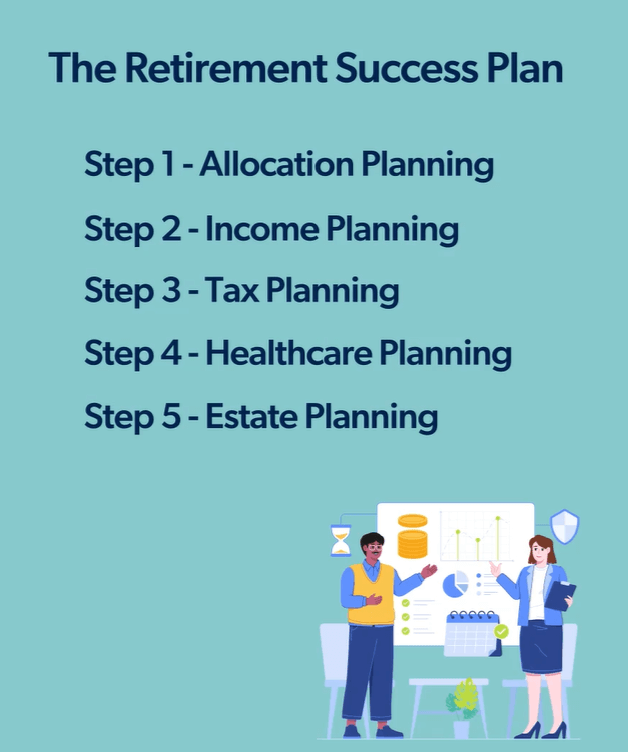
Everything I just shared with you is basically the first two steps of the retirement success plan. I firmly, firmly believe that in order to have peace of mind in retirement, those are the foundational elements, the first two steps. Allocation planning is what we call it, making sure that your portfolio’s actual risk is congruent with your willingness to take risk, and then an income strategy, knowing how much you can spend. Those are the foundational elements. Step three, tax planning, that adds a lot of value to the overall plan itself. The foundational, the core elements of what makes a retirement plan successful, and you peaceful or having peace of mind in times of chaos is those first two steps.
That’s what we want to focus on in this video. I’m not going to dive too much into numbers, although, of course, I am. I really just want to convey and stress the importance of those first two steps of the retirement success plan and why we preach this all the time on this channel and literally have made hundreds and hundreds of videos dedicated to helping you understand these concepts. The very first thing we have to do is identify your willingness. When someone comes to see us for the very first time, we look at the portfolio. We get to know who you are, what you want to spend. We do an analysis of three primary things. We’re looking at your risk, we’re looking at your income, and we’re looking at your taxes. Those are the first three components that we’re going to perform an analysis on.
Measuring Real Risk in Dollars, Not Percentages
Now, the risk has to come first because investments create risk, and whatever combination of investments you have creates varying levels of risk. Without investments, you don’t have income. Investments and risks have to come before income. Then, without income, there are no taxes. Of course, income has to be planned before taxes. Those three things are ultimately done together, but there is a logical sequence to those. Identifying your willingness. It is critical that you do this in terms of dollars.
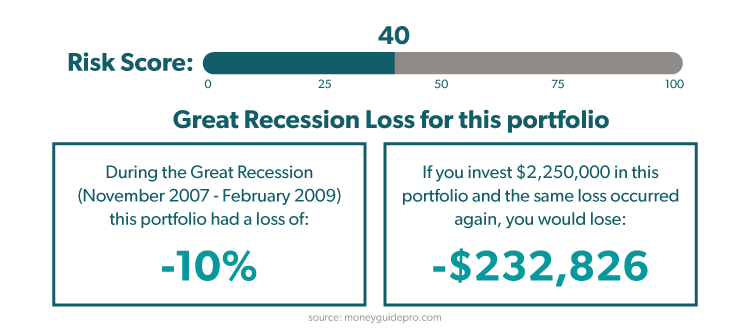
Here we have, this is just one of the tools that we’ll use, and it’s setting a risk score from 0 to 100. It’s going to create a 10% or 20% performance during the Great Recession. This is what we want to focus on here.
Long time ago, I had someone come in and had about $2 million. He said, “Troy, I’m about a medium risk.” I said, “Okay, let me convert that to dollars for you. What does that mean percentage-wise?” He says, “Well, 10% or so, I think I’d be comfortable losing.” I said, “Okay, 10% of $2 million is $200,000. Are you comfortable if your accounts go down $200,000 in the next three months?” He said, “No, I’d fire you instantly.” Point being is that he was not a medium risk tolerance. 10% was far more risk than he was actually willing to take and stay committed to, because you have to expect a 10% decline in the stock market. It happens virtually every single year in this country. I think it’s around 70%.
What we’re actually going through right now, again, this is April 2025. We had those couple of historic down days. The market was up 9%, 10% yesterday. It’s down big again today, as of this morning. This is extreme volatility. The amount of swing, 10%, 15% decline on the S&P 500, although it happens swiftly, it’s not unnormal. It’s something that happens typically throughout a year in the stock market. You have to be comfortable with these swings. We have to identify in terms of dollars. When we’re running through this with a prospective client, and we do this with existing clients as well, because your risk willingness changes as you age and go through retirement. We always want to do this in terms of dollars.
Two Things We Need to Know to Calculate Your Risk Tolerance
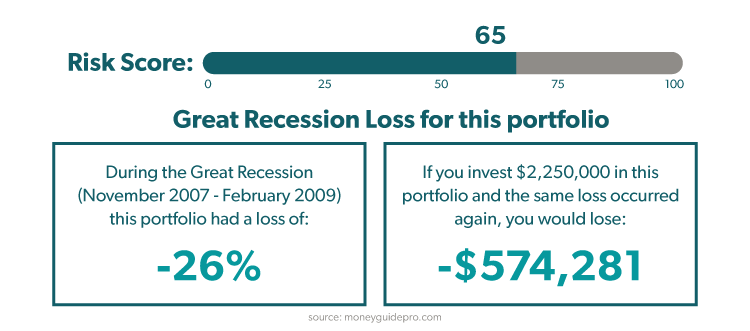
Here’s about a $2.2 million portfolio. Don’t worry about the numbers if you have more, if you have less. This is just the typical client that we see here at Oak Harvest Financial Group. I would be asking this question, $574,000. If the portfolio went down $570,000, how does that make you feel? Okay, and so here’s the key. It’s the gut reaction. It’s the very first response. It’s not often when you think about it, you ask your spouse, she asks you. That is typically not the right answer. It’s your gut reaction. It’s your instinct, because that is the response that will kick in when the markets are going wild.
This is what we want to do. We want to focus on this number. Now, most people that we sit with are going to be in this range here. Around about $232,000. Now, we have some clients that are 100% stock. They’re comfortable with it. They have plenty of money. They don’t worry about what it does in the short term. Other clients, they don’t have $2 million. They have less than that. They’re more sensitive to volatility. A lot of clients that do have $2, $3 million, they are also very sensitive to volatility. Here’s the secret. You don’t need to make 10% a year. If you need to make 10% a year, you probably shouldn’t retire. What we need is a range of volatility that you’re comfortable with. Then we need to know how much can we comfortably spend?
That’s the second part of what we’re going to get into today. We’re going to go through what’s called a go-go spending plan. Most of you spend far too little dollars in retirement. You could likely spend a lot more. We’re going to stress test some different income scenarios. I’m going to bring that back to the risk in the portfolio. Then we’re going to see how that all works together. First thing that you must do in retirement is understand how the different ingredients that you have in your portfolio, percentage of stocks, what type of stocks, percentage of bonds, the real estate, whatever tools that you’re using as a recipe as part of your overall portfolio in retirement, what is the likely outcome if things get bad in terms of dollars?
Spending Patterns and Your Retirement Outcome
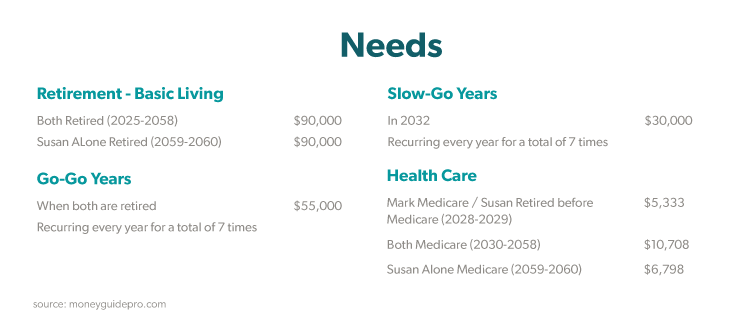
Okay, so in this hypothetical case study, we have Mark and Susan. Mark is 62. Susan is 60. Coming in, they say, “You know what, Troy? We have a baseline of about $90,000 that we want to spend throughout retirement. Pretty comfortable. Our standard of living before we retired, we spent about $90,000. You know what? Now that we are retired, we have this bucket list and these things that we want to do. In the first seven years, we actually want to spend an additional $55,000.” That brings it up to about $145,000 for those first seven years of retirement. They’re younger. They’re more active. They want to travel. They want to do more things.
They want to take the kids and the grandkids, everyone together. They want to pay for everything, go to the beach, go to the mountains. They just want to enjoy family and enjoy their retirement. This is what we call a go-go spending plan. They say, “You know what? After that seven years is done, we’re still going to want to do some things, but probably not as much.” We’re going to do this slow go where we’re going to take the 90, and we want an additional 30. 55 for the first seven, and that goes away. Then the baseline plus 30. Now we’re about 120,000 of spendable money. This is after tax for the next seven years.
Healthcare is included in these expenses prior to Medicare. Then once Medicare kicks on, we have that cost in here. This is just the average for a couple their age right now in this country for Medicare Part B, Part D, et cetera, not a pocket cost. Okay. This is the first plan that we are going to stress test and see based on the assets that you have and your willingness to take risk, that 40 risk score, that equates to a certain type of portfolio. Can that portfolio provide enough growth to generate this level of income at what confidence level?
Planning for Inflation in Retirement
First, I want to show you visually what this looks like. This is important because when I talk about these levels of income, you have to account for inflation. I want you to see what that actually means, because these are dollars that have to come out of your portfolio over time. The problem with inflation is that you have to pull more and more out to maintain the same purchasing power over time. Then, of course, you have taxes to be concerned with. If taxes go up or down, that alters how much you have to pull out of the portfolio as well. Forget about taxes. We’re not getting into taxes on this video. We’re just looking at income and then the volatility range we talked about earlier.
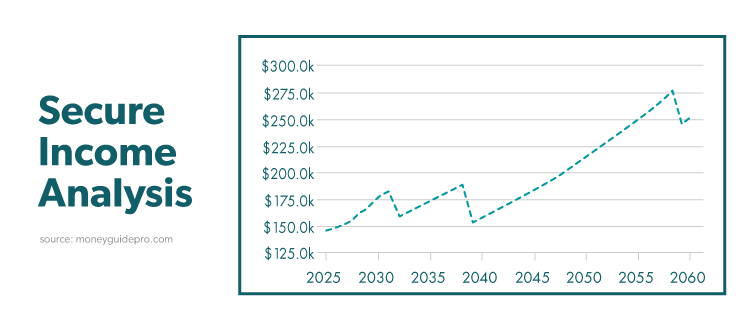
Visually, this is what this go-go, slow-go, and then our baseline. This is the baseline 90,000 with 2.5% inflation for the rest of retirement. We see here, we’re starting at the $145,000. Then the end of seven years, that $145,000 is now up to $182,000 because of inflation. We have to spend $182,000 to purchase the same amount of goods and services as we did in the beginning of retirement to equal $145,000. Then we get that drop. It drops down to in today’s dollars, $120,000 of purchasing power. That was the 90 baseline plus 30 in the slow-go years. Inflation-adjusted, we actually need $158,000 to spend.
If all of your money’s in the retirement account, I know I said I wasn’t going to get into taxes, but you have to pull out more because you pay income taxes, and then you spend $158,000. Again, don’t worry about the numbers if you don’t have $2 million. If you have $700,000, this applies to you. The numbers are just less. If you have $5 million, this applies to you. The numbers are just more. Okay. Slow-go, we have the inflation. Now we’re at $190,000 roughly at the end of the slow-go years. That all goes away. Then we drop down to the baseline here. This is the $90,000. You’re still moderately active here.
Look, as we go throughout retirement to maintain that same spending, it increases. Now you may not spend as much. You may spend more. You may spend less. Medical expenses may occur. There’s a bunch of uncertainty. I just want to visually show you because I learn better from seeing things on the screen, and I think most of you do as well. This is what we need to be looking at if you’re building your own income plan or you’re just thinking out into the future, “Hey, do we have enough? How much can we spend?” These are some of the things that we need to be aware of. Visually, I believe, drives that point home a bit better.
Stress Testing Your Retirement Plan
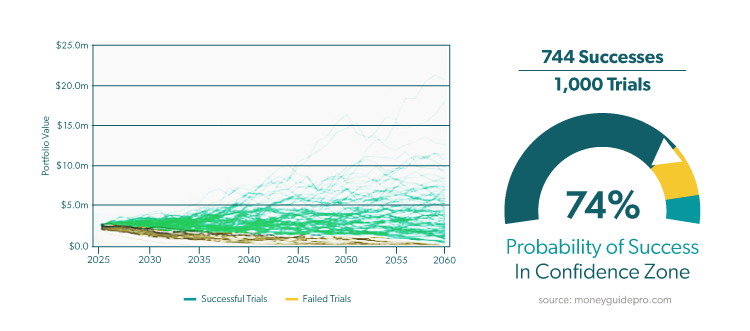
Now we’re going to run the probability model. It’s a Monte Carlo simulation to see, based on everything that we’ve covered in this video so far, what are the odds that Mark and Susan pass away with money still in their accounts? Okay. It comes in at 74%. Not ideal. We probably want to be 85, 90, maybe above 90. If you’re at 99, you definitely probably could spend more money because 74 still means that out of 1,000 retirements with these exact numbers, 740 of them, you’re likely to pass away with money. In 260, you don’t, but you still have Social Security.
This is more of a personal decision. I’m not going to tell you you can’t retire if you come back at 74. You’re a big boy. You’re a big girl. You can make these decisions. We’re just here to help you understand how it all comes together to help you see the big picture. Let’s say Mark and Susan said, “Troy, you know what? I’m not really comfortable at 74. Let’s bring the spending down.” From there, we would go into the play zone and start to play with some of these numbers to see what we can do to get the number up and where or how much the spending has to drop to get to that comfort zone.
First thing we’re going to do is start with the baseline lifetime spending number, because it was 90,000 at retirement. That adjusts at 2.5% inflation throughout retirement. I’m not going to alter the go-go and slow-go yet because I want to see what happens with the baseline spending. If we bring this down to 80, let’s say 78. Okay. Now we’re up to 94. Now we’re at, let’s call it 80. Healthcare is, again, post-Medicare. That’s the out-of-pocket expenses, Part D, that reduces your Social Security, Part D. We have the go-go, so 80 plus 55 is 135. For the first seven years, at $135,000 of spending, we come in at about 94%.
Then the slow-go, still at 30, so that’s 80 plus 30, that’s 110. Basically, we’ve dropped the baseline spending from retirement, from day zero, through the end of life. We dropped that about $10,000, $12,000 here. That gets us up to about 94% probability of success. Then we might go around and say, okay, what happens if we want to spend a little bit more in the first 10 years? Drops it down to 91. Okay, so by reducing the baseline, we can actually still keep the first seven years, the go-go, at that roughly 145. This is actually getting up to, yes, 140, about 145. Point being is, okay, now we’re starting to see the impact of our decisions. Also, what we need to do to adjust course to put ourselves into a more secure position.
This is what I mean when I say staying connected to your plan. Because this is something that we would look at every six months. Where are we at? The market is down 10%. Your portfolio, we better be in that range because you told me you don’t want to lose more than 10%. The portfolio should only be down 4%, 5%, 65, 7%, somewhere in that range. We’re not going to have massive up years with that type of portfolio. You’re not going to have plus 25. You don’t need plus 25 for this income. For this particular level of risk, for the spending, comfort, and retirement that they’re looking for, they probably just need to make 4%, 5%, 6%.
Secure Income Analysis and Ways to Increase Stability in Volatility
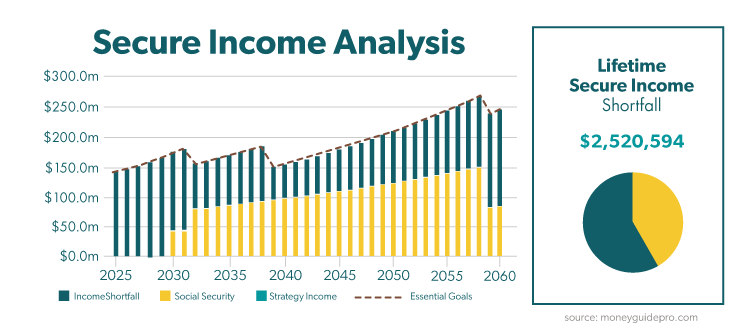 Now we’re going to look at the secure income analysis because in the original plan, it came in at 74%. We just simply had a conservative portfolio of stocks and bonds. Here we’re looking at how much secure income is coming from. One thing that I know, that I’ve learned from sitting with thousands of people and putting together over 1,000 retirement plans over the course of my career, is when you see those plans work out, the people who have multiple sources of income coming in during retirement, those incomes are not impacted by the stock market’s ups and downs. They tend to be the most happy. They call us the less. They have the least amount of questions. They’re just comfortable. They’re out spending time with friends and family.
I had someone recently come in and didn’t even know that the stock market was down because they don’t ever look at it because all of their, between Social Security and their other sources of income that come in, they don’t worry about it. They don’t look at it. That’s the part of retirement planning we started this video with. It’s about comfortably spending. It’s not about being tied to your computer screen and tied to the stock market’s performance. We simply want you to be comfortable. That’s how I believe you create this internal happiness and peace of mind, and you’re able to tune out that noise.
Here we have a color-coded chart representing the secure sources of income. Blue is Social Security. Red is the shortfall, where we don’t have secure sources of income coming in. We have to take portfolio withdrawals. The orange represents the original go-go, slow-go income plan. Then we see, this is the one coming in at 74% here. We see why this could be a bit of a stressful retirement because to achieve those spending goals, there really isn’t a lot of comfort. Because if we get significant downturns in the market in consecutive years, you can see how anxiety would start to creep into the picture.
What I Would Personally Do in This Situation
Now, I’m going to show you what I would personally do in this situation, and what I plan on doing for my own retirement. I’m 44. Right now, I’m 100% stock, and I’m going to be that way probably for the next, minimally, six, seven, eight years. Probably closer to 10, just depends how long I work. Probably 10 to 15 more years, something like that. Probably around age 50 to 55, somewhere in that range, I’m going to take a portion of my money and set it aside to generate guaranteed income for me in the future to supplement Social Security. It just makes sense.
The reason I’m going to do this is because I’ve done this long enough to know that the people that are most happy are the ones that have multiple sources of stable income coming in. What we’re going to do now is I have two options. I just want to show. This is the guaranteed income strategy, where we take $500,000, we set it to the side, and we defer it for five years. Now we see the different color here. The dark blue is still Social Security. We have the lighter color. This is the guaranteed income. One, we see how much smaller the shortfalls are.
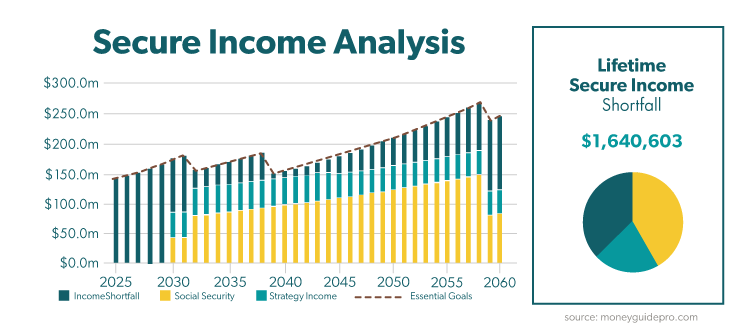
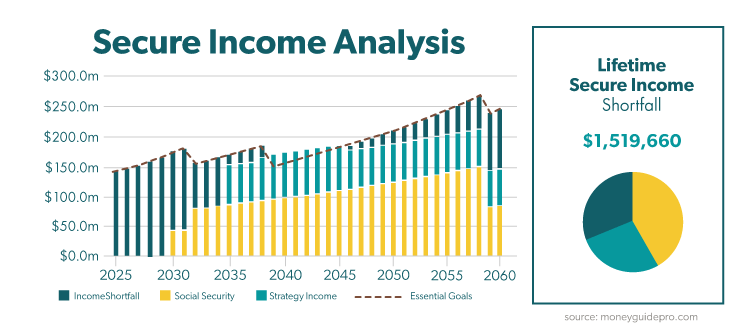
Let’s say that’s still not good enough. We want to look at a 10-year deferral. Say, “Troy, I’m fine over the next 10 years or so, making these portfolio withdrawals, living off interest.” Now, what we do with the 10-year deferral strategy, look at how much more secure the back end of our retirement is. We can comfortably pull, live off some interest, maybe pull a little bit from principal here. Social Security kicks in, guaranteed income kicks in. Now, we have a high level of comfort with spending for our entire retirement, not just when it kicks in. I’ll tell you what happens. You have a much higher degree of comfort in the beginning because you know how much income is going to be there on the back end.
The Impact of Multiple Sources of Income from a Probability Standpoint
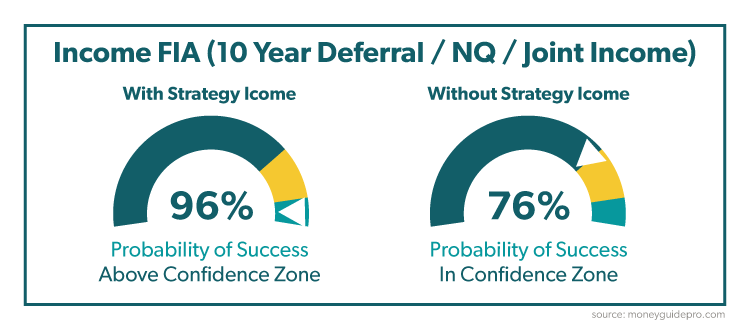
That is a real game changer for retirement where you don’t have to worry about the stock market’s performance to generate the income that you need. There’s a level of comfort there that I found is really unmatched with any other strategy available. Okay, so now I want to show you the impact that it has from a probability standpoint. With the strategy income, with the guaranteed income, here we’re looking at the 10-year deferral. It increases the original plan that came in at 76% without any guaranteed income, increases that original go-go plan from 76% to 96%.
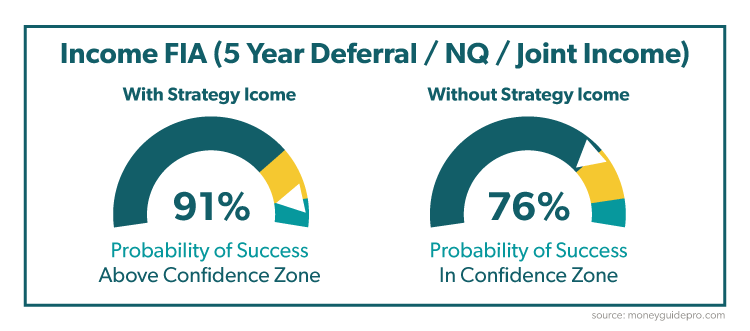
If we get rid of the 10-year and just look at the 5-year deferral option for guaranteed income. This is taking some money, dedicating it to a future source of stable income. If you pass away, you get that money back. The insurance company doesn’t keep it, but it’s a tool that’s available for you in retirement to generate stable income. This is something I’m going to do myself because I find that it brings the most peace of mind to the greatest amount of people. When you have $140,000, $150,000 of income coming in without any concern of the stock market’s performance, it just helps you live more comfortably in retirement and not worry about it as much.
The five-year comes down to 91%. When you’re choosing between 5 or 10-year, you don’t have to do that up front. You can do that annually. You can actually take income in year three or year four or year six, or year seven. I just want to show you examples of what it does from a probability standpoint, because again, we’re in the middle of the stock market sell-off. It’s tremendously chaotic. Really test your willingness to stay invested in the market. It’s important to understand that retirement is not about taking excessive risk. It’s about having a portfolio and a comfortable range of volatility that you can stick to, that you can stay with your plan, but then having an income strategy that no matter what the stock market is doing, you’re comfortable spending money. You don’t have to pull back.
The level of income that we’re spending here, it’s far greater than the 4% rule. One of the great travesties of retirement without having a plan that you’re connected to and actually having money dedicated to specific tools to generate income, is that most people spend too little in retirement. You could be spending a lot more, which means doing the things that you love with the people you care about. That’s what this is really all about.
Now, to put some numbers to this, the five-year deferral, it’s a $500,000 deposit. After five years of deferral, about $50,000 a year of guaranteed lifetime for both spouses. The one with a 10-year deferral, that’s $500,000 deferring for 10 years and $78,000 per year for life for as long as both spouses are alive. Okay, now I’m back in the play zone with the original baseline $90,000 of spending plus the go-go and the slow-go. We’ve added the five-year deferral guaranteed income here. I just want to play around with it a little bit to show you how it creates a little bit more stability.
Let’s go up to $107,000 as the baseline. Okay, so too much. We know we can’t have $107,000 as the baseline. I’d probably bring that down back to $90,000. Then what I would do is I would probably want to play with the go-go. Let’s say we brought this up and we spent another $13,000 on top of that, $91,000 to $82,000. That’s a comfortable range for me. This is that extra $13,000 a year or so. Okay, maybe that’s two first-class tickets to Europe that we weren’t going to spend otherwise, whatever it might be. There’s a bigger range of comfort here. Then maybe we do that for one or two years or three or four.
The point is we’re staying connected to the plan. We have multiple sources of income coming in. Because we have Social Security guaranteed for life plus a portion of the portfolio dedicated to future guaranteed income for joint life, for both lives, we can feel more comfortable spending money today because we know the income is going to be there for us in the future. We’ve really minimized the emotional impact that stock market chaos can have on your retirement.
Analyzing The Portfolio Value Chart
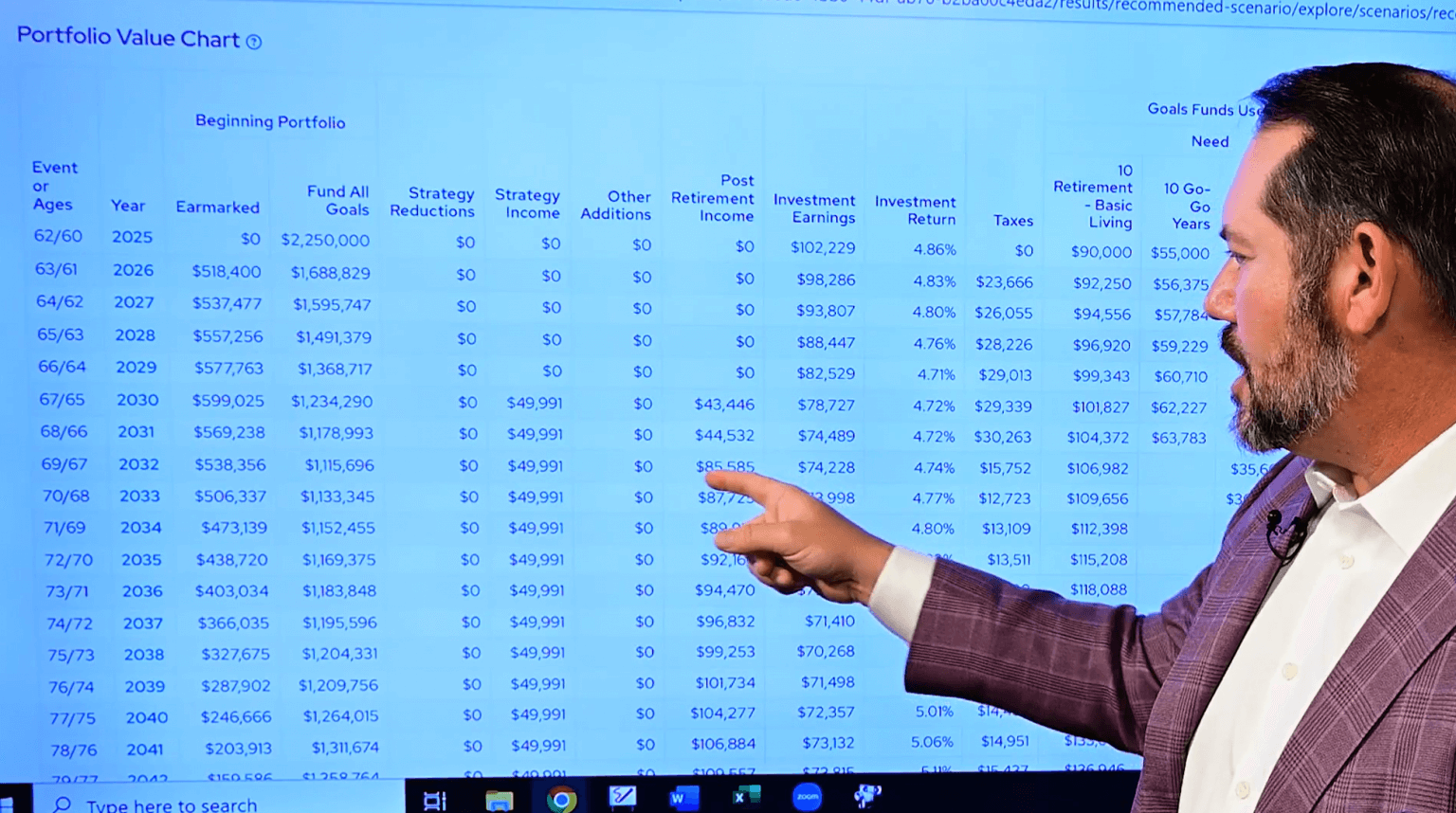
Okay, so for our engineers out there, for those who like spreadsheets. I wanted to show you this.
Source: Money Guide Pro
Here we have the earmark, the $500,000 set aside for future guaranteed income. Here’s the portfolio, its remaining value. This is all I wanted to show you. We’re looking at the five-year deferred plus the Social Security income. Here, post-retirement, one spouse turns it on, the second spouse turns it on. Right here in 2032, ages 69 and 67, we have about $50,000 in one stream of income coming in from the future guaranteed income plus 85 of Social Security. That’s combined Social Securities.
Now we’re at $135,000 of baseline income. This is where the level of comfort comes in. This is why I really like this and why I’m going to do this personally, because regardless of how the stock market performs from here, these two sources of income are guaranteed lifetime income. Stocks go up, stocks go down. Is that a comfortable level of, let’s call it paychecks or playchecks, whatever you want to call it? It’s just mailbox money that’s being deposited every single month, which I found does provide a little bit more security and a bit better ability to deal with the emotional ups and downs of stock market chaos.
The Retirement Plan You Deserve
I hope this has been educational. The big takeaway, of course, is have a portfolio within a range of volatility that you are comfortable with, and then have a plan to generate income that allows you to feel that comfort, not have anxiety when the stock market goes crazy, and most importantly, be able to spend comfortably when the stock market is doing this. If you have questions, if any of this is appealing to you, and you’d like to learn more, of course, you can reach out to us. I thank you for your time, and we look forward to seeing you on the next video.
➡️ Do you need a Retirement Success Plan that goes beyond allocating funds to truly fit your needs? We can help you create a retirement life plan customized for your retirement vision and legacy. Call us at (877) 404-0177 or fill out this form for a free consultation: click2retire.com/market-downturn