

“Liberation Day” = Economic Uncertainty
Index, sector & asset Performance
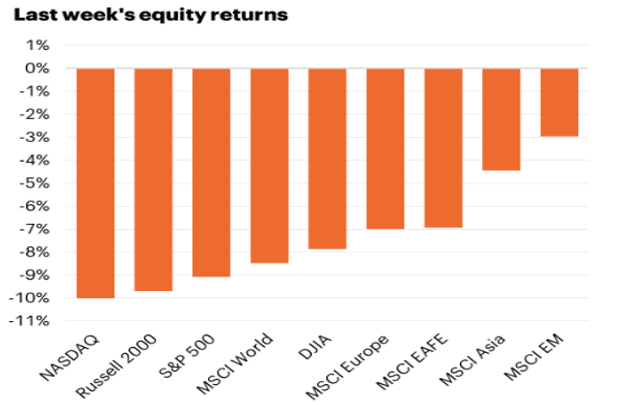
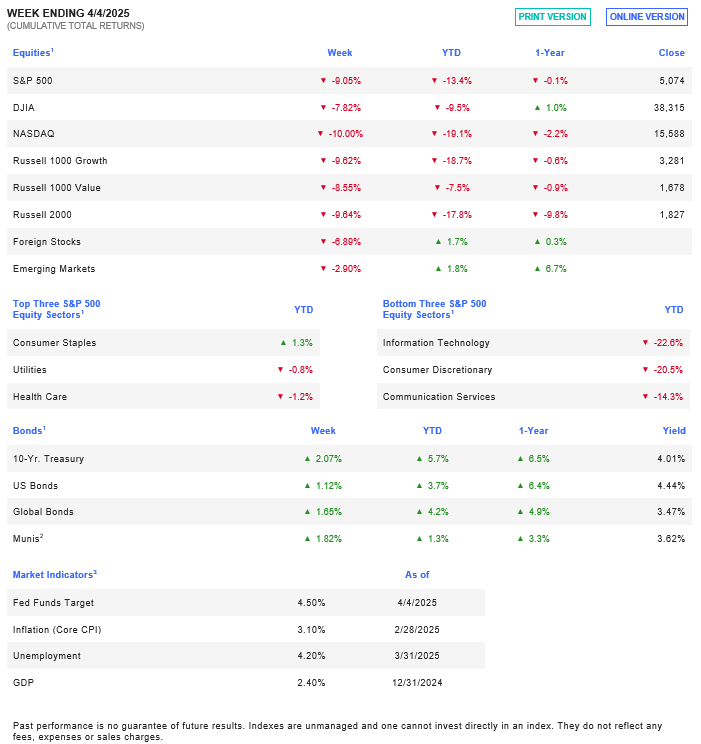
Even prior to “Liberation Day”, economic growth worries were trumping inflation worries in the financial markets. The S&P 500 fell -9.1% last week amid concerns about the impact of President Trump’s “reciprocal” tariffs on global economic growth. The S&P 500 ended last week at 5,074 after falling -5.8% in March. It’s now down -13.7% since the start of the year.
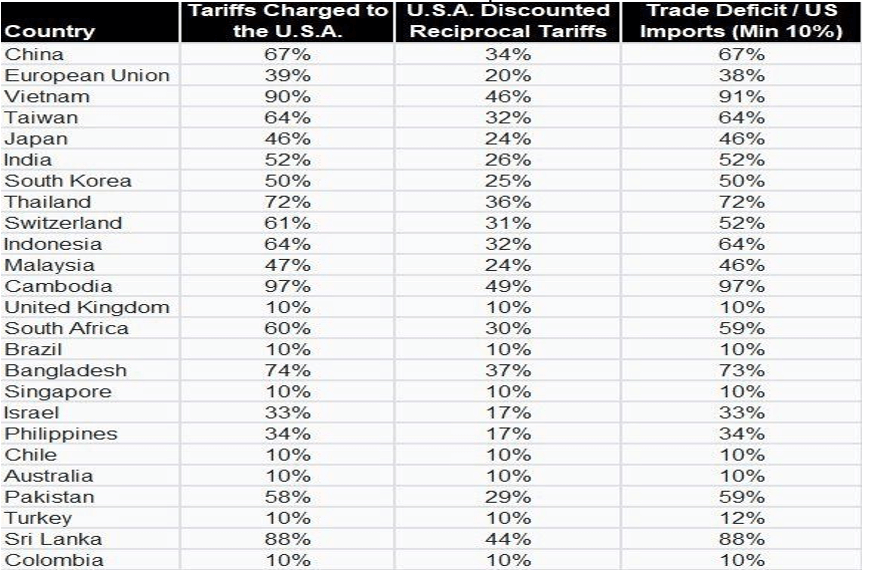
The President’s Liberation Day brought a shock to all financial markets that were expecting 10% across the board tariffs. Instead, they got a calculation which substituted goods trade deficits for tariffs. It ignored trade in services completely. The formula the Trump team came up with is about trade imbalances with the U.S. rather than reciprocal tariffs.
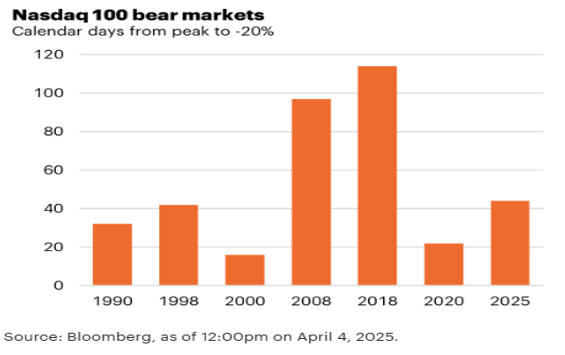
The -20% Nasdaq drawdown occurred in just 44 days, making it the fastest bear market and in the categories of Covid, the dot com crash, and October 1987.
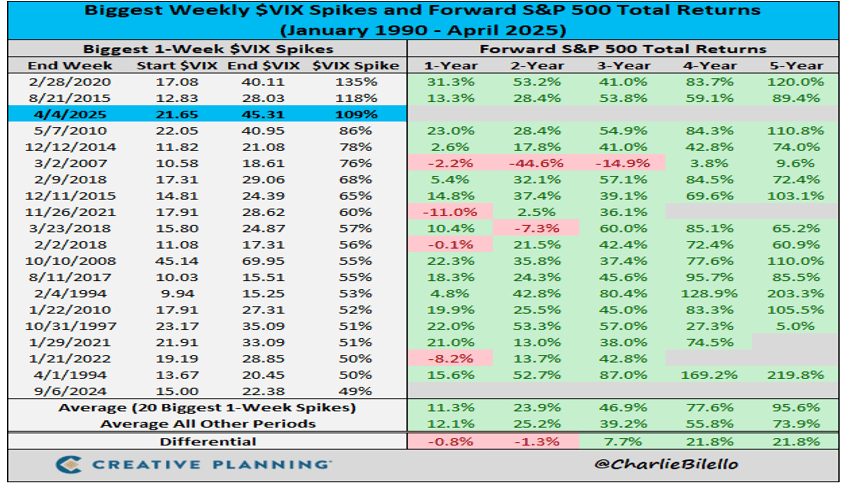
The 30-day VIX jumped above 45. This VIX index spike of up almost 110% in one week made it the third fastest move higher ever, right behind Covid in 2020 and China’s Black Monday in mid-2015. Charlie Bilello and Creative planning always out with great data showing historic 1yr through 5 years forward returns on VIX spikes like these.
All sectors of the S&P 500 fell last week. Cyclical and economically sensitive stocks fell the most. Energy dropped -14%, followed by -11% decline in technology, a -10% loss in financials and a -9.4% decrease in industrials. Among technology stocks, AI stocks were hit the hardest along with hardware names sourcing from overseas. Micron Technology (MU) fell -26%. Investors worry that US grant recipients in the microchip industry, including Taiwan Semiconductor Manufacturing (TSM), Micron Technology, and Texas Instruments (TXN), face pressure to expand domestic operations or risk losing funding.
A summary of last week’s negative returns from FS Investments:
Interest rates continued lower for the wrong reasons, slower growth expectations. The financial markets now sees between four and five rate cuts in 2025, with the first cut likely in June. So much for those prescient Fed Funds futures calls a few weeks ago.
Fed Chair Jerome Powell took a measured approach to the market’s volatility. He stated it’s “too soon” to decide on the rate path and that the Fed should act as a source of “stability”. The 10-year Treasury yield fell below 4% for the first time since October of last year. High yield bond spreads widened to 427 bps which is their widest since late 2023’s slowdown.
Economic indicators and Earnings commentary
Last week’s economic releases continued to demonstrate a divide between hard vs, soft data. The labor data were solid, as the U.S. added +228k jobs last month, though that reflects surveys done in the second week of March.
Durable goods orders rose +1%, indicating a healthy level of business spending and perhaps some tariff front-running. The ISM Mfg. Index dipped to 49.
Markets will focus on the CPI report this week.
Global market trends/Commodities/Currencies
Crude prices crashed with other risk assets with WTI ending the week at $62/bbl. This is its lowest since 2021. Tariffs will stunt global growth and oil demand. At the same time, OPEC+ shocked the market by increasing oil supply by three times more than expected.
Gold rose to begin the week but later dropped as investors sold everything. During times of extreme stress, correlations all go to 1, except cash.
Oak Harvest Weekly Stock Talk: Real Interest Rates vs. Stocks: A Dangerous Shift?
https://www.youtube.com/watch?v=tEYLzUIoNN4
The preceding discussion is for informational purposes only. Investing involves risk and no reference to any security listed above should be considered a buy or sell recommendation. Past performance is no guarantee of future results. Advisory services are provided through Oak Harvest Investment Services, LLC, a registered investment adviser.