

Weekend Update, March 3rd, 2025
Index, Sector & Asset Performance
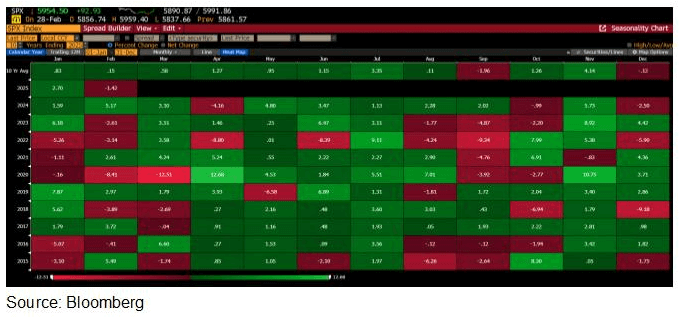
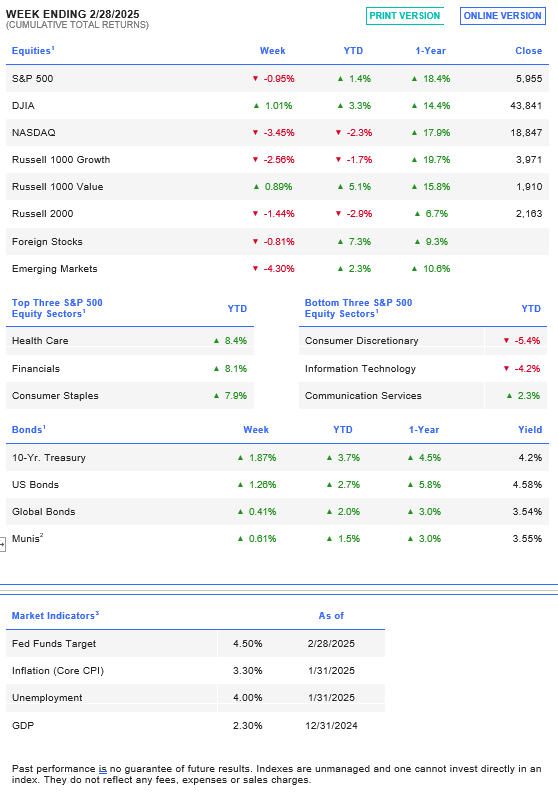
The S&P 500 ended its normal seasonally weak, 2nd half of February with a strong Friday rally ending at 5945. US equities fell -2.5% by Thursday’s close, hitting down -5.0% in less than a week, before jumping +1.60% on Friday to end the week down a net -0.95%. The first two months of 2025 are in the books with January gaining +2.7% and February declining -1.42%. Here’s the S&P 500 seasonality matrix for the last 10 years from Bloomberg. So far, nothing out of the ordinary to see especially for 1st year Presidential terms.
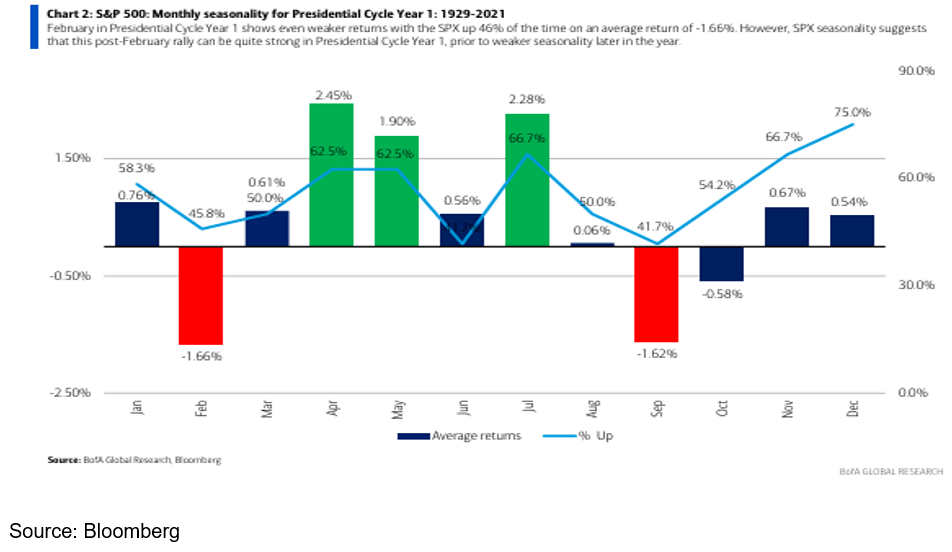
The year-to-date performance of the S&P 500 mirrors historical 1st year Presidential term seasonals. Here is that data from Steve Suttmeier’s group at BAC-Merrill Lynch. The good news? Seasonals start improving at the end of February if history is a guide
The market’s mood was dampened by Trump administration proposed 25% tariff on EU imports. Nvidia earnings failed to uplift investor spirits despite reporting a revenue beat. With most tech stocks, the markets wait on trough gross margins, and with Nvidia the markets await a further ramp in its Blackwell chip.
The technology sector had the largest percentage drop of the week, falling -4%, followed by a -2.6% decline in communication services and a -2.1% drop in consumer discretionary. Utilities also fell as many AI “power” names now fall in this group.
The Mag 7 index sits almost -12% beneath it December 6th peak. In communication services, Alphabet’s (GOOGL) shares fell -5.2%. European and Asian equities fell on the backs of broadening tariff threats.
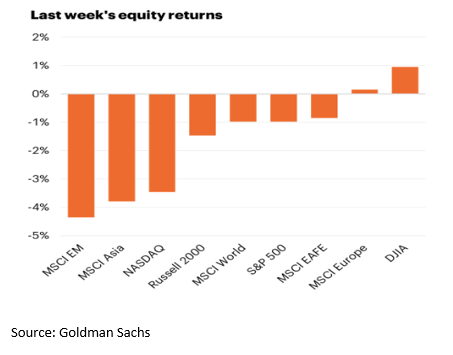
The value biased DJIA index led last week’s asset returns.
Opposite the late December near hysteria on financial TV about rising interest rates, yields continue to make new lows. U.S. 10-year yields declined again last week as tariff news dominated headlines. As the real time data has been said since mid-December, financial outlets are finally discovering, investors are fearing a growth slowdown. A combination of a commitment to tariffs by the Trump administration plus increased job layoffs by DOGE, are weighing on investor sentiment. These softened 10-year yields an additional 5bps on Friday to close the week at 4.21%. FWIW, growth expectations normally trough at the end of February through mid-March just as inflation concerns peak seasonally.
Economic Indicators and Earnings Commentary
Personal income in January grew month on month +0.9%. This exceeded expectations of +0.4%. As previewed for weeks, the consumer is losing momentum. Personal consumption declined by -0.2% m/m. This fell short of expectations for an increase of +0.2%. Personal spending slowed partly due to weather, the LA wildfires, and payback from a strong holiday shopping season.
For those tracking government data series, U.S. GDP is now estimated to be negative in 1q25, according to the Atlanta Fed. We plead with followers to generally ignore government data as it is “late”, falsely precise, almost always inaccurate, and revised time and time again over months and quarters. This GDP number would be a slowdown from 2.9% in the 4q24.
The Fed’s favorite inflation metric, core PCE inflation was released on Friday and in line with estimates.
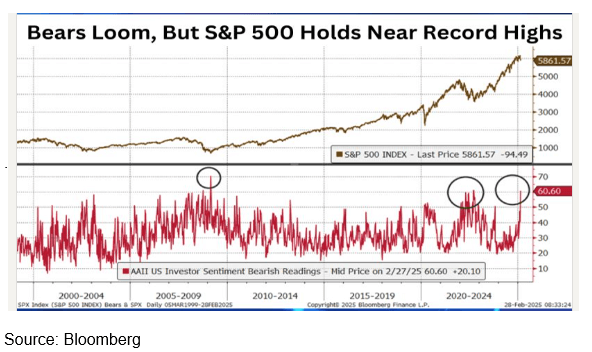
We have referenced AAII investment sentiment data at extremes many times over my 7 years here at OHFG, including near the panic Covid lows in 2020, making a case for buying, not selling stocks. This measure of investor sentiment has historically been a very good contrary indicator with the markets troughing when bears are high, and the S&P500 peaking when bears are very low.
Here’s an updated chart of just the bearish component of AAII hitting highs only seen at the Covid lows and lows in the GFC in 1q2009. There have only been six other weeks in this survey’s history when the percentage of bears was higher. Those coincided with the recession of 1990, Iraq’s invasion of Kuwait, just after the Great Financial Crisis, and at the near bottom of the bear market in September 2022.
Broadcom (AVGO), Costco Wholesale (COST) and CrowdStrike Holdings (CRWD) are among the companies expected to release quarterly results.
Global Market Trends/Commodities/Currencies
Oil prices are doing nothing fast at $70bbl. Oil prices remained relatively stable, closing out the week with a slight decline of -0.91%. Supply concerns and uncertainty resurfaced following President Trump’s revocation of a license granted to Chevron for operations in Venezuela.
Gold prices decreased as the dollar strengthened, driven by the Trump administration’s announcement of tariffs on Canada, Mexico, and China.
Bitcoin experienced a sharp decline, falling nearly -13% last week and was down over -25% from its peak. This morning Crypto prices exploded higher on the back of Trumps strategic crypto reserve weekend tweet.
The U.S. dollar bounce last week but is back near its downtrend and our team believes it will decline most of 2025 which would be good for 2h2025 and 2026 earnings.
Oak Harvest Weekly Stock Talk
Stock Rallies Start Here: Friday Fights and Stock Flights
The preceding discussion is for informational purposes only. Investing involves risk and no reference to any security listed above should be considered a buy or sell recommendation. Past performance is no guarantee of future results.