

Where is the “Double-Dip Recession”?
2021-01-18 Market Update.
U.S. markets are closed for the Martin Luther King Jr. Day holiday. The S&P 500 fell 1.5% last week on weaker economic data (initial jobless claims by +181,00 incrementally last week and retail sales missed forecasts) and equity hedging in front of this week’s Inauguration Day on Wednesday.
Drama does not change reality
Despite all the drama of recent weeks, most projections for the U.S. economic outlook for 2021 have not changed. (Recall just 4 months ago, many TV pundits were parroting a looming “double dip” recession). First quarter growth is expected to slow to 1% annualized (a very normal slowdown) before reaccelerating higher in the spring on easing restrictions, fiscal stimulus, pent-up demand and excess savings.
After contracting about 3.5% last year, real GDP could rise 4.5%–5% in 2021, returning to pre-virus levels by the third quarter. Barring more restrictions to suppress the second wave (biggest economic risk), there are waves of fiscal support to ensure a strong recovery following passage of the recent $900 billion virus stimulus bill (equal to 4.3% of GDP). We do not expect the recent $1.9 trillion Biden administration proposal to pass in its entirety as it includes far too many non-virus “add-ins,” such as doubling the minimum wage. Expect the number to be closer to $1.1–1.5 trillion, which is still a huge number by any stretch.
Federal Reserve stimulus
We also have not changed our view that the Federal Reserve is in no hurry to slow their stimulus, despite a potential firehose of fiscal spending. Chair Powell made clear last week that the Fed is not even “thinking” of letting up, as it is nowhere near achieving its goals. These goals now include pushing inflation moderately above target for some time and maximizing both the number and distribution of jobs in the economy.
Bond yields
We expect the 10-year Treasury yield to increase toward 2% by the first half of 2022. As one can see from the accompanying chart, this kind of rise is normal this cycle, post Federal Reserve “QE” push and presidential elections. Post 2012 and 2016 Presidential elections (both QE time periods), the 10-year Treasury yield rose over 150 basis points (Bps) the next 15 to 24 months. A similar move the next 15 to 24 months would push the 10-year Treasury to between 2.10-2.15%.
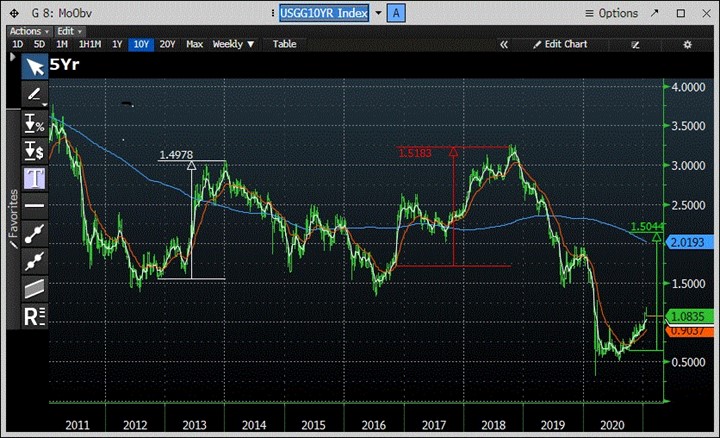
While concerning to some, this increase in yields should not hurt the overall ongoing bull market for the next year. Here are a few interesting articles for your reading, one on a view of this bull market and the second on the power of compound interest which Albert Einstein deemed “the Eighth wonder of the world.”
Resources
- https://www.bloomberg.com/news/articles/2021-01-16/a-very-young-bull-market-in-stocks-is-still-minting-believers
- https://seekingalpha.com/article/4399445-compounding-massive-power-of-time-and-building-generational-wealth
Weekly market updates contain general information and expresses views of Oak Harvest Investment Services. Data, Articles, and information cited are believed to be reliable at the time of creation, but are not guaranteed. Nothing in this content is intended as, nor should it be regarded as, personalized investment advice. Strategies and ideas discussed may not be right for you. Views and opinions expressed may change without notice and do not constitute a recommendation, or an offer or solicitation to buy or sell securities. In addition, Oak Harvest makes no assurance as to the accuracy of any forecast made. Indexes like the S&P 500 are not available for direct investment and your results may differ. Past performance is not indicative of future results. Investing involves the risk of loss.

