
Think Like a Retiree, Not an Investor
Quick Answer: What Does It Mean to Think Like a Retiree?
Many people believe retirement is simply the point when they stop working. In reality, retirement begins when your financial priorities shift from growing wealth to living from it. Instead of focusing solely on maximizing investment returns, retirees must balance income, taxes, Social Security, healthcare, market risk, and spending decisions. In this video, Troy Sharpe explains why successful retirement isn’t about having the biggest portfolio—it’s about making smarter decisions across your entire financial life.
Key Takeaways
- Retirement requires a completely different mindset than investing during your working years.
- Maximizing returns becomes less important than optimizing income, taxes, and withdrawals.
- Every retirement decision affects other parts of your financial plan.
- Poor retirement decisions often don’t become obvious until years later.
- Sequence of returns risk can permanently impact retirement income.
- Your portfolio is only one part of a successful retirement strategy.
Who This Video Is For
This discussion is especially valuable if you are:
- Within 10 years of retirement
- Recently retired
- Wondering if your retirement savings will last
- Concerned about market volatility
- Trying to create sustainable retirement income
- Deciding when to claim Social Security
- Looking for ways to make smarter retirement decisions
Why Your Retirement Mindset Matters
Many people spend decades learning how to accumulate wealth but very little time learning how to spend it wisely. Retirement introduces new challenges—including taxes, withdrawal strategies, healthcare costs, and sequence of returns risk—that don’t exist during your working years. Developing the right decision-making framework can help retirees feel more confident and avoid mistakes that may not become visible until years later.
Transcript
Why Retirement Requires a Different Mindset
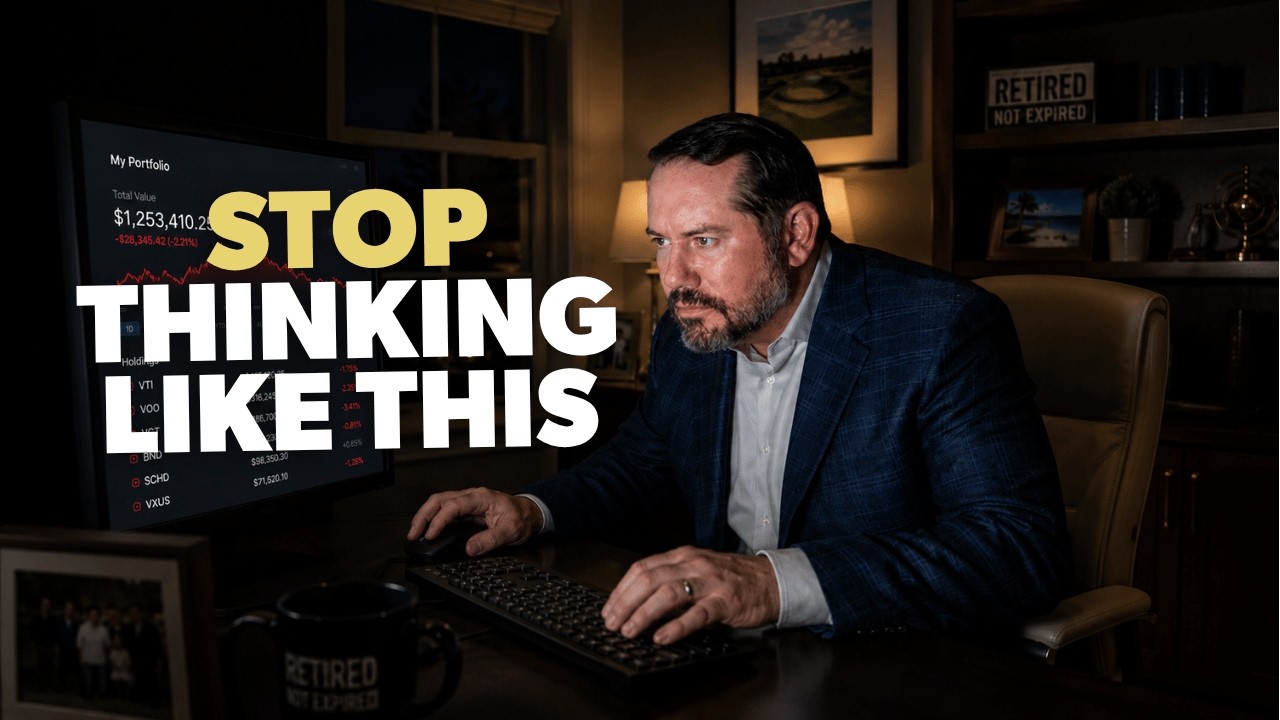
Most people think retirement begins when you finish work. But retirement actually begins, I believe, when you start thinking like a retiree. One of the traits that makes people most successful in that shift from the working phase to the retirement phase is the psychology, how they look at their decisions, how they look at the framework from which they make those decisions. And that’s what I’m going to share with you in this video today.
I’ve been doing this a long time. I’ve sat with thousands of clients. And the things I’m going to share with you in this video doesn’t necessarily mean if you don’t make these mind shifts that you won’t be successful. Just from my experience, they help the majority of people ease into retirement, help them experience retirement a little bit better. And I’m going to share them with you.
Investors vs. Retirees: The Biggest Difference
So, very first thing we want to get into is the difference between how investors look at investments and finance and markets versus how in retirement we found it’s beneficial to look at the same situation.
So when we’re looking at our money and you’re in the accumulation phase, the goal is to grow wealth. I mean, that is your singular goal. Of course, you need to save money, you need to work it, focus on lifestyle elements, family, kid, etc. But we’re just talking about your money here.
Investors focus on growing wealth. People in retirement, they focus on living off that wealth. They have the big questions: Do I have enough? How long will my money last? If something happens to me, will my spouse be okay?
So growing wealth, living off the wealth. You have more time as an investor when you’re in the accumulation phase. Time fixes mistakes. But in retirement, a lack of time compounds those same mistakes.
Investors are always trying to maximize returns. In retirement, we have to optimize everything. So it’s not just about your returns, that’s one facet, but we have to optimize everything in retirement.
Market declines equal opportunity. So when we’re contributing to our 401k, market goes down every couple of weeks, we put money into the account. That’s good. We’re buying when markets are down.
In retirement, now we’re dealing with the emotional element. How long is the market going to stay down? Is it going to continue to go down? Should I stop taking money out of my portfolio? Should I reduce the withdrawals? All of these elements increase risk.
So market declines are opportunities when you’re an investor, but when you’re in retirement, they equal risk.
Why Your Portfolio Isn’t the Whole Story
And of course, the portfolio is the center of everything for an investor, maximizing returns, achieving the greatest growth over time. After-tax income comes first in retirement because without income, there is no retirement. So you have to take the money that you’ve accumulated, you have to distribute it intelligently, and you have retirement accounts, non-IRAs, Roth accounts, you have all of these different elements that work together.
But it’s not about the portfolio being at the center of your universe. It’s an important element, but income and after-tax income is one of the most important elements of a successful retirement.
In the accumulation phase, investors focus primarily on risk and returns. As I said previously, the portfolio is the center of the entire universe. But in retirement, risk and returns, they’re just part of a much greater system.
They play a role, of course. We need to understand how to manage risk, minimize risk, generate returns that are sufficient to create income that keeps up with inflation. But our goal in retirement is to optimize an entire system.
It’s not just about accumulation, it’s not about saving, earning the maximum amount of returns, taking risks because you have time on your side. We have a system that we have to manage, and it’s critical to understand that each component of this system—and this is not everything—bleeds into the next.
Meaning if I make a decision about my portfolio, risk and returns here, well that determines how much my accounts may grow, how much the accounts may go down in a bad market scenario. That determines how much income that I can take. How much income I take, depending on if it’s in my IRA or my non-IRA or my Roth, depends how much taxes I pay.
If I have emergencies, I need to do a foundation repair, I need to do an air conditioner, something like that. I need to take more income. Where do I take it from? That impacts my taxes.
I don’t even have Social Security up here, but Social Security creates the structure of your entire retirement. When you take Social Security, it impacts everything else here. So in retirement, it’s not about just maximizing returns.
They’re important, but they’re just one spoke in the wheel. In retirement, we have to optimize an entire system.
How Small Decisions Become Big Mistakes
Now, in retirement, time changes everything. I think most of you understand that, but we’ve been told that for many years through the lens of our investment portfolio or the investments that we make.
In retirement, we know that when we have an investment that goes south, we have less time to make up for those losses. But what I’m talking about are not investment losses. What I’m talking about are your decisions.
Because in retirement, when you make bad decisions, the consequences don’t show up immediately. It’s not like you just went to a resort and got pinned down in a room and had to buy a timeshare, and now three weeks later you regret it.
In retirement, you make decisions that silently compound, and you don’t often know that they’re bad decisions until four, five, six, seven years later. And many times you don’t ever know that they were bad decisions. You just have a lot less money, a lot less income, or potentially paying a lot more taxes than you otherwise would.
So they’re oftentimes not only silent, but they’re invisible.
Let’s say first year of retirement, you want to go on a vacation. Second year of retirement, you want to do a home repair. Third year of retirement, you want to help the children.
Well, each one of those choices, you have to make a decision on where you withdraw that income from. And let’s say you draw it from one account one year, another account another year, and then a different account one year. Maybe you’re trying to diversify your withdrawals.
Is that the optimal withdrawal structure and sequencing for your particular circumstance? You don’t know. And it’s not going to show up on any financial statement. No one’s gonna knock on your door and say, “Hey, you know what? You pulled money from the wrong accounts there.”
So this is why we need to optimize an entire system in retirement. But it’s not just that time impacts your investments and the ability to make up for losses. Time really impacts your decision making.
In retirement, it’s not just that time is limited when it comes to making up for investment losses, it’s that time is a constraint when it comes to making up for bad decisions.
Retirement Is About Trade-Offs
The cure to making bad decisions is to make the trade-offs of those decisions visible.
Now, in retirement, decisions aren’t always black and white. There’s no clear right answer, oftentimes. This is why many of you may hear me say retirement planning is more of an art than a science, because we have to make decisions in an unknown environment with hundreds, if not thousands, of variables today and in the future that we can’t possibly pin down.
So we have to take all of the information that we have. And we have to make some assumptions about the future, and we have to do so in an environment that may be—there may be stress, there may be some emotional things going on. So it’s an imperfect system.
But the way that we find to make the best decisions that you possibly can is to look at that decision, understand the trade-offs of the alternative routes that you can go, but then understand the domino effect, the chain effect of those decisions and how they interact with everything else in the system.
The Psychology Shift Nobody Expects
The final point I want to bring home here is when you’re an investor or in retirement, you can go through the same market, but there are significantly different consequences for going through that market.
So let me share a story with you, and then I want to share two technical concepts. So I knew somebody a long time ago who was very, very aggressive when it came to the accumulation phase. When I first met him, he was 100% stock.
He said, “Troy, I’m always going to be 100% stock. You know, this is just who I am. This is how I like to invest.”
So, about a year into retirement or so, the markets got real choppy and he was pulling money out, enjoying retirement. But he came in to see me. And then when we had the same conversation, he says, “Troy, I never thought this, but I’ve completely changed.”
When the market got choppy and I was taking income out of my portfolio and I had no more paychecks coming in, all of a sudden, the way I looked at spending money, the way I looked at maybe going on another vacation, he says, all of that changed. He says, “I had no idea that the psychology of money, the psychology of retirement, the psychology of my thought process, I had no idea that was going to change from that one experience in my first year of retirement.”
Sequence of Returns Risk Explained
So, what he went through is something that’s called sequence of returns risk with an amplifier effect.
So if you’ve watched a lot of videos on this channel, you probably have heard me talk about sequence risk before, but you have not heard me talk about amplifier risk because this is the first time I’m bringing it up on this YouTube channel, which is a little bit surprising to me.
When you’re working and the market goes down, that’s an opportunity. That’s what I just kind of went through when he told me, “I’m 100% stock and I’m gonna always be this way,” because he kept buying. And when the markets were down, every two weeks his paycheck would go into a down market.
The dollars you invest when the market is down are your highest return on invested capital dollars. If I buy here and I buy here, 30 years from now, these are going to provide a much higher return on my invested capital than these dollars. So that’s opportunity.
But in retirement, the psychology changes.
What he was going through is sequence risk. And real quickly, that’s just the combination of taking money out of your portfolio while markets are going down. You lose 10%, you take five, you’re down 15%.
So that’s the sequence of returns risk in retirement.
The amplifier effect is because you’re taking withdrawals and suffering losses, how long it takes you to get back to break even where you were. So even if the market starts to rebound, you still have to continue to take money out.
So the fact that you have to continue to take money out, it amplifies the hole essentially that you’re in. It amplifies the amount of time it takes to get back to where you were.
And in most scenarios, without very high returns averaging 9, 10, 12, 15%, you’re probably not going to get back to where you were after consecutive years of market losses, sequence of returns risk, and taking income.
So that’s what he was going through. And although we don’t necessarily always know the technical terms, we know the feelings, we know the emotions. What we don’t want to happen is for those emotions to impact your behavior.
How Market Losses Change Spending Behavior
Because in retirement, it’s much more likely that when you go through negative experiences, that they impact the way that you interact with the other decisions that you have to make. They change your behavior.
So I’ll share a quick story with you. Many, many years ago, I had somebody come in and she was looking to change firms. And I said, “What’s important to you? Why are you here? What’s going on with your current firm?”
She said, “Troy, I’ve talked to them many times. I told them what I want. And at this point, the markets are going down and I just don’t feel comfortable. I’m losing money.”
I said, “Well, tell me more.”
She says, “Well, it’s changed the way that I behave. We used to go see my daughter twice a year. We would buy the plane tickets, wouldn’t think about it. And now that the market’s down, we’re talking about driving.”
She said, “We used to go out to good restaurants at least once a week and have date night, my husband and I. Now we’re either eating at home or we’re going somewhere else that’s less expensive.”
So that’s a good example of how the sequence of returns risk and the withdrawal amplifier that it creates over time because you have to continue to take money out, how it amplifies the time it takes to get back to zero, how it can alter your behavior. And that’s what we don’t want happening in your retirement.
The One Mindset Every Retiree Needs
Okay, so let me wrap this up and leave you with one final piece of advice that may change the way that you look at retirement for the better.
Investors say, “How much money can I make?” Retirees say, “How much money can I safely spend?”
In the working years, you’re maximizing growth. You’re trying to achieve higher rates of return over time because market losses don’t impact you as much. In retirement, you have to optimize a system.
You have to have sustainable withdrawals. You have to manage your own taxes as far as where you pull money from, what goes on your tax return. You have to keep up with inflation.
You have to make Social Security decisions, Medicare decisions, long-term care, health care, estate plan, wills, trust. This is an entire system that needs to be optimized.
And that’s one of the big differences between the accumulation phase and the retirement phase, or an investor or somebody in retirement who’s looking at things a bit differently.
The day you retire, your portfolio doesn’t become a less important part. It just becomes a part of a much bigger system.
So the one piece of advice that I want to leave you with is that most people in retirement don’t need a better portfolio. What they need is a better decision-making framework—something that helps the trade-offs of every decision that you have to make become visible and then the interaction those decisions, once they’re made, have with the tax code and what that does to your retirement.
➡️ Take the free Retirement Readiness Score Quiz to get a quick snapshot of how prepared you may be for retirement and where planning gaps could exist. https://click2retire.com/4fuYf9T
➡️ Want to see how your retirement income, taxes, investments, healthcare, and estate plan work together? Schedule a free visit with our team and start building a retirement strategy designed around your goals. https://click2retire.com/45kMr5g
Frequently Asked Questions
What does it mean to think like a retiree?
Thinking like a retiree means shifting your focus from maximizing investment growth to creating sustainable income while managing taxes, withdrawals, healthcare costs, and market risk.
Why isn’t investment performance enough in retirement?
Retirement success depends on much more than portfolio returns. Income planning, tax efficiency, Social Security timing, healthcare costs, and spending decisions all influence how long your money lasts.
What is sequence of returns risk?
Sequence of returns risk occurs when investment losses happen early in retirement while you’re simultaneously withdrawing money from your portfolio. This combination can permanently reduce retirement income.
Why do retirement withdrawals matter?
Where you withdraw money from—taxable accounts, IRAs, or Roth accounts—can significantly affect taxes, portfolio longevity, and future retirement income.
Why is retirement planning different than investing?
Investing focuses primarily on growing assets. Retirement planning coordinates investments, income, taxes, Social Security, Medicare, healthcare, estate planning, and spending into one strategy.
When should I start thinking like a retiree?
Ideally, several years before retirement so you have time to develop an income strategy and understand how your financial decisions interact.
Can market downturns affect retirement differently?
Yes. During retirement, market declines can become more damaging because you’re withdrawing assets instead of adding to them through ongoing savings.
How can I make better retirement decisions?
Create a retirement plan that evaluates the trade-offs between income, taxes, investment withdrawals, Social Security, and future spending needs instead of looking at each decision independently.
Related Reading
How Much Monthly Retirement Income Can $750,000 Generate?
I’m 60 With $1.5 Million. Can I Retire?
I’m 60 With $1 Million. How Much Can I Expect To Spend In Retirement?
Why Retirement Could Make Your Taxes Go Up
The Social Security Tax Torpedo Explained
I’m 60 With $1.5 Million for Retirement: How a Roth Conversion Ladder Can Save Up to $600K in Taxes